If you have a full-size or compact Glock with the MOS optics cut, you have several Trijicon red dots available to you. This guide is specifically for Gen4 and Gen5 Glock MOS slides. It does not apply to the newer Gen6 ORS cut, and it also does not apply to the Glock 43X or 48, which use a different Slimline MOS optic cut.
Trijicon makes some of the most proven and trusted pistol optics on the market, and the Glock MOS provides a flexible mounting system for pairing them with your handgun. In this article, we’ll cover which Trijicon optics fit the Glock MOS, what adapter plates they require, and the important differences between each option. The goal is to make it easy to determine exactly what you need before ordering anything.
Which Glock models does this apply to?
|
Will Fit
|
Will Fit
|
Will Not Fit
|
Which Trijicon optics do we recommend for the Glock MOS?
Why Consider a Trijicon Red Dot?
Trijicon has a long history of producing optics for military, law-enforcement, duty, defensive, and civilian use. The RMR in particular helped establish the standard for a rugged pistol-mounted red dot and has built a reputation for continuing to work under hard use, harsh weather, and heavy recoil.
Trijicon pistol optics are made in the USA at the company’s facility in Wixom, Michigan. Their housings, electronics, and mounting systems are designed with durability and dependable performance in mind, which is why Trijicon remains one of the most trusted names for duty and defensive optics.
Whether you want a traditional RMR, a modern multi-reticle optic, an enclosed emitter, or a large-window competition sight, Trijicon offers an option that will fit your Glock MOS.
What optics footprint is the Glock MOS?
Glock uses a proprietary optic cut known as the MOS, or Modular Optic System. Because the slide does not use the same mounting footprint as a Trijicon optic, you will need an adapter plate to install any of the Trijicon red dots covered in this guide.
What adapter plates exist for the Glock MOS?
All of the Trijicon optics covered in this guide use the RMR footprint, so you will need a Glock MOS-to-RMR adapter plate.
Some Glock MOS pistols were supplied with a set of factory adapter plates, including the Glock #2 plate for RMR-footprint optics. You can use this OEM plate, but we generally prefer aftermarket plates from Calculated Kinetics, C&H Precision, or DPP Titanium. These plates typically provide a more secure fit and are better alternatives to the factory Glock plate.
Best RMR-Footprint Trijicon Optics for the Glock MOS
1. Trijicon RMR Type 2 Adjustable - Best All-Around Duty Optic

Buy the RMR Type 2 Adjustable At The Best Price
When most people refer to the “Trijicon RMR Type 2,” the Adjustable LED model is usually the optic they have in mind. It is one of the most recognizable and proven pistol red dots ever made, with a long history of use on duty, defensive, and concealed-carry pistols. It uses the standard RMR footprint and features Trijicon’s distinctive “owl ear” housing, which is designed to absorb impacts and redirect stress away from the lens for exceptional durability.
The RMR Type 2 Adjustable is available with red 1 MOA, 3.25 MOA, and 6.5 MOA dots. A green 3.25 MOA model is also available. Its forged 7075-T6 aluminum housing weighs approximately 1.2 ounces with the battery installed. The window measures 0.87 × 0.63 inches, and the optic is waterproof to 20 meters.
Side-mounted buttons provide eight manual brightness settings, including two night vision settings. You can also place the optic into automatic mode, allowing it to adjust the dot’s brightness based on surrounding light. Button Lock-In and Lock-Out modes let you either maintain a chosen brightness level or prevent accidental button presses.
The optic is powered by a CR2032 battery located underneath the housing. This means the optic must be removed from the pistol to replace the battery and may need to be checked or re-zeroed afterward. We recommend installing the RMR Type 2 with a sealing plate, especially when the mounting surface does not completely cover and seal the underside of the optic.
Who is it for? The RMR Type 2 Adjustable is best for duty, concealed carry, and defensive users who prioritize proven durability and want direct control over the dot’s brightness. It is also the most versatile RMR Type 2 model for anyone who wants a choice of reticle sizes or the option of a red or green dot.
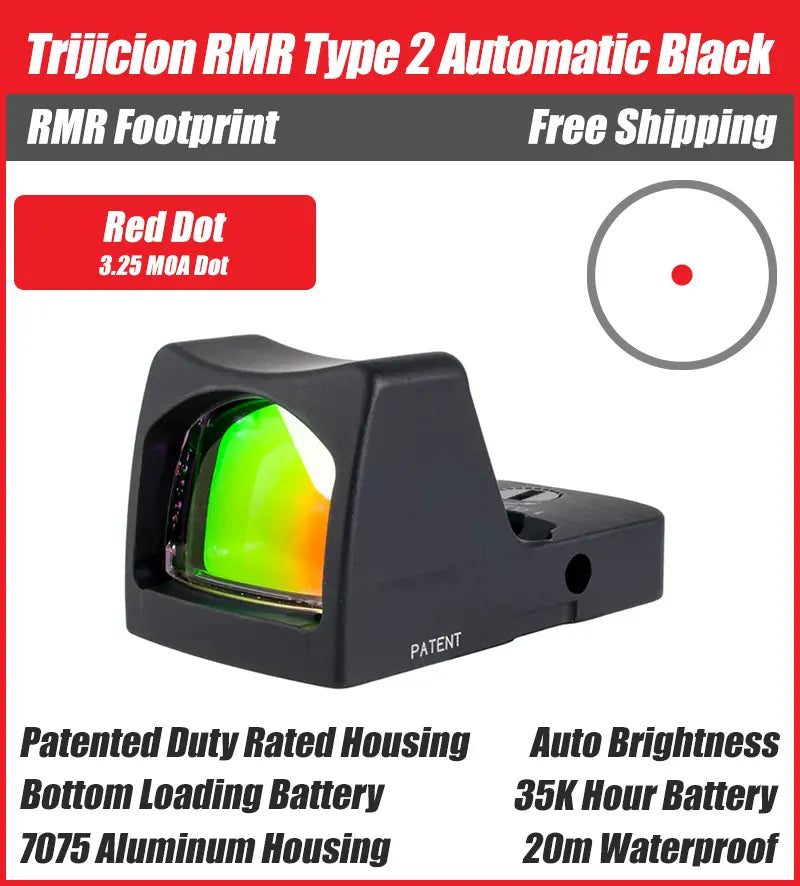
2. Trijicon RMR Type 2 Automatic - Best Set-and-Forget RMR
Buy the RMR Type 2 Automatic At The Best Price
The Trijicon RMR Type 2 Automatic offers the same proven durability and distinctive “owl ear” housing as the Adjustable model, but with a much simpler operating system.
Unlike the Adjustable RMR, the Automatic has no buttons on the sides of the housing. Its built-in light sensor automatically controls the dot’s brightness based on the surrounding lighting conditions. There is no manual brightness adjustment or night vision mode, making this a straightforward optic that does not require the user to manage any settings.
The current RMR Type 2 Automatic is offered with a red 3.25 MOA dot. Its forged 7075-T6 aluminum housing weighs approximately 1.2 ounces with the battery installed. The window measures 0.87 × 0.63 inches, and the optic is waterproof to 20 meters.
The optic is powered by a CR2032 battery located underneath the housing. This means the optic must be removed from the pistol for a battery change and may need to be checked or re-zeroed afterward. We recommend installing it with a sealing plate, especially when the mounting surface does not completely cover and seal the underside of the optic.
Who is it for? The RMR Type 2 Automatic is best for someone who wants the proven durability of an RMR at a lower price and prefers a simple, always-automatic optic.
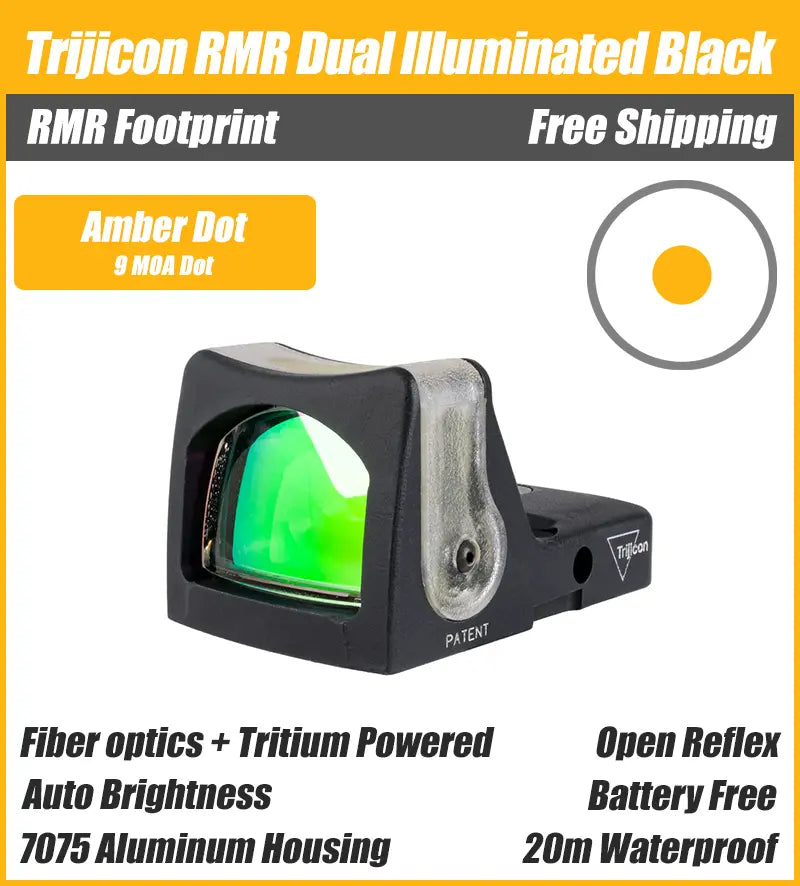
3. Trijicon RMR Type 2 Dual Illuminated - Best Battery-Free Option
Buy the RMR Type 2 Dual Illuminated At The Best Price
The Trijicon RMR Dual-Illuminated is the battery-free option within the RMR family. It shares the same standard RMR footprint, proven duty-grade construction, and distinctive “owl ear” housing as the other RMR models.
Rather than using an LED and battery, the Dual-Illuminated RMR combines fiber optics with tritium. During the day, the fiber-optic system gathers ambient light and automatically adjusts the reticle’s brightness. In dark or low-light conditions, the tritium illuminates the reticle without requiring batteries or electronics. There are no side buttons, manual brightness settings, or power controls.
The current Dual-Illuminated models feature a large 9 MOA dot available in either green or amber. The larger reticle is designed to remain easy to see with the fiber-optic and tritium illumination system, although it will not provide the same level of precision as the smaller dots available in the battery-powered RMR models. Its forged 7075-T6 aluminum housing weighs approximately 1.2 ounces. The window measures 0.87 × 0.63 inches, and the optic is waterproof to 20 meters.
Because the optic does not use a battery, there is never a battery to purchase or replace, and the optic does not have to be removed for routine battery changes.
Who is it for? The RMR Dual-Illuminated is best for someone who wants an extremely simple, durable optic with no batteries or electronic controls to manage. Its large reticle is well suited for fast target acquisition, but the Adjustable or Automatic LED models may be better for users who want a smaller aiming point or more consistent illumination across different lighting conditions.
4. Trijicon RMR HD - Best Modern RMR Upgrade
Buy the RMR HD At The Best Price
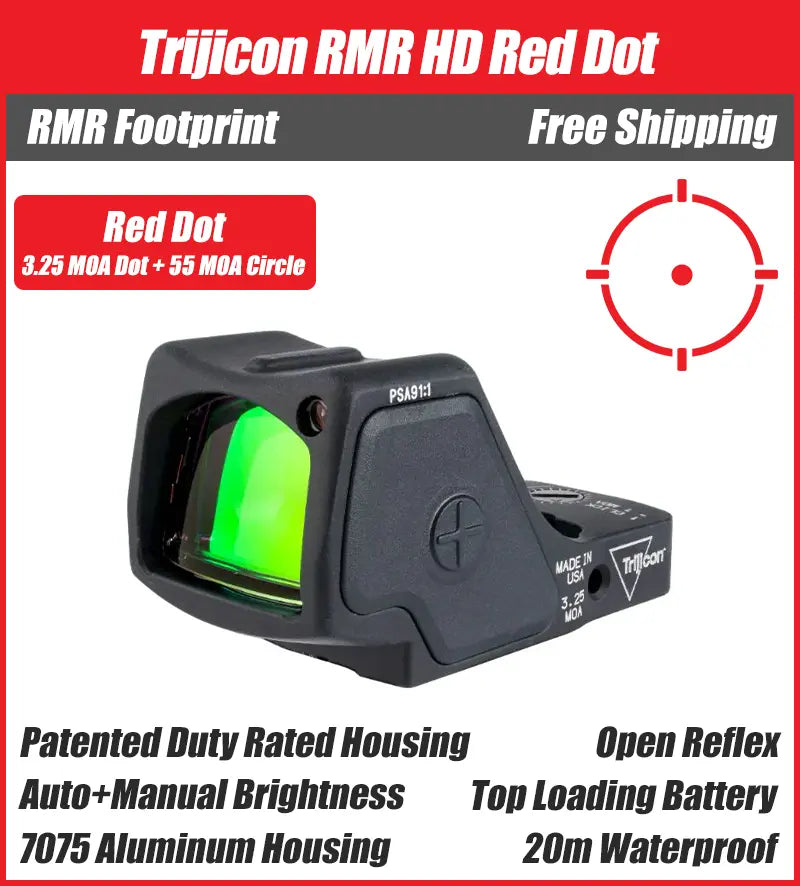
The Trijicon RMR HD is essentially the next evolution of the RMR Type 2 Adjustable. It remains an open-emitter optic with the standard RMR footprint, but adds a larger window, upgraded controls, improved automatic brightness, and a more convenient battery system. It retains the RMR’s iconic “owl ear” housing, although the protective hood and window extend farther forward than those of the standard RMR Type 2.
The RMR HD was Trijicon’s first pistol optic to offer a selectable multi-reticle system. It is available with either a 1 MOA or 3.25 MOA center dot, with both versions incorporating a selectable 55 MOA segmented circle. The user can choose between the center dot by itself or the dot-and-circle combination.
The RMR HD offers automatic and manual brightness control. Its forward-facing light sensor measures the lighting conditions near the target rather than only the ambient light surrounding the shooter. This helps the automatic mode select a more appropriate brightness when aiming from a dark area into a bright area or when using a weapon-mounted light. It also has nine manual brightness settings, including three night vision settings and one super-bright setting.
A top-loading CR2032 battery allows the battery to be replaced without removing the optic from the pistol or disturbing its zero. Unlike the standard RMR Type 2, the RMR HD does not require a sealing plate. Its forged 7075-T6 aluminum housing weighs approximately 1.69 ounces, the window measures 0.89 × 0.67 inches, and the optic is waterproof to 20 meters. Battery life is rated at more than three years when using the dot-only reticle at brightness setting five.
Who is it for? The RMR HD is best for duty, concealed-carry, and defensive users who like the proven RMR design but want modern features such as multiple reticles, improved automatic brightness, a slightly larger window, and a top-loading battery.
5. Trijicon RCR - Best Duty Enclosed Emitter
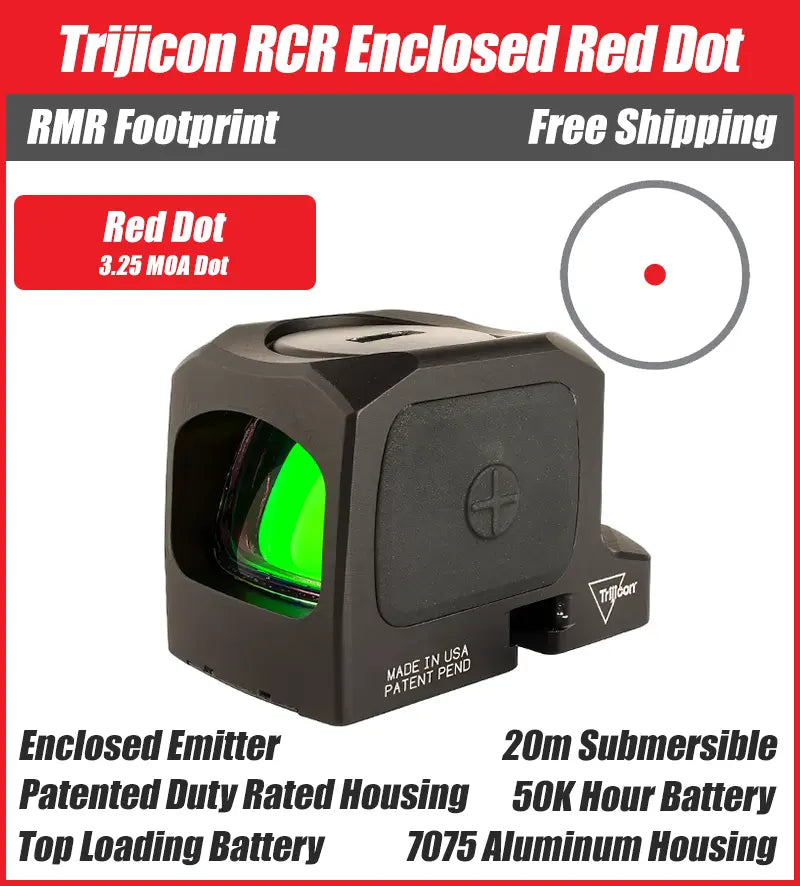
The Trijicon RCR is essentially the enclosed-emitter version of the RMR Type 2. It uses the same RMR footprint and was designed to provide the durability and reliability associated with the RMR while completely protecting the emitter from rain, dirt, lint, dust, and other debris. This makes it especially well suited for duty use, concealed carry, and harsh environments.
The RCR is offered with a red 3.25 MOA dot and uses manual brightness control only. It has ten brightness settings, including three night vision settings and one super-bright setting.
A top-loading CR2032 battery allows the battery to be replaced without removing the optic from the pistol or disturbing its zero. It also eliminates the need for a sealing plate. Battery life is rated at more than six years of continuous use at brightness setting five, giving it a significantly longer runtime than the RMR Type 2 Adjustable.
Although the RCR uses the standard RMR footprint and mounting-hole pattern, it attaches using Trijicon’s proprietary Capstan screws. The optic includes #6-32 Capstan screws, and screw compatibility should be confirmed before purchasing.
Its 7075-T6 aluminum housing weighs approximately 1.95 ounces. The window measures 0.88 × 0.64 inches, and the optic is waterproof to 20 meters.
Who is it for? If you like the durability, footprint, and straightforward design of the RMR Type 2 but want the additional protection of an enclosed emitter, the Trijicon RCR is made for you. It is best for duty, defensive, and concealed-carry users who prioritize reliability and long battery life over automatic brightness or multiple reticle options.
6. Trijicon SRO - Best Competition Open Emitter
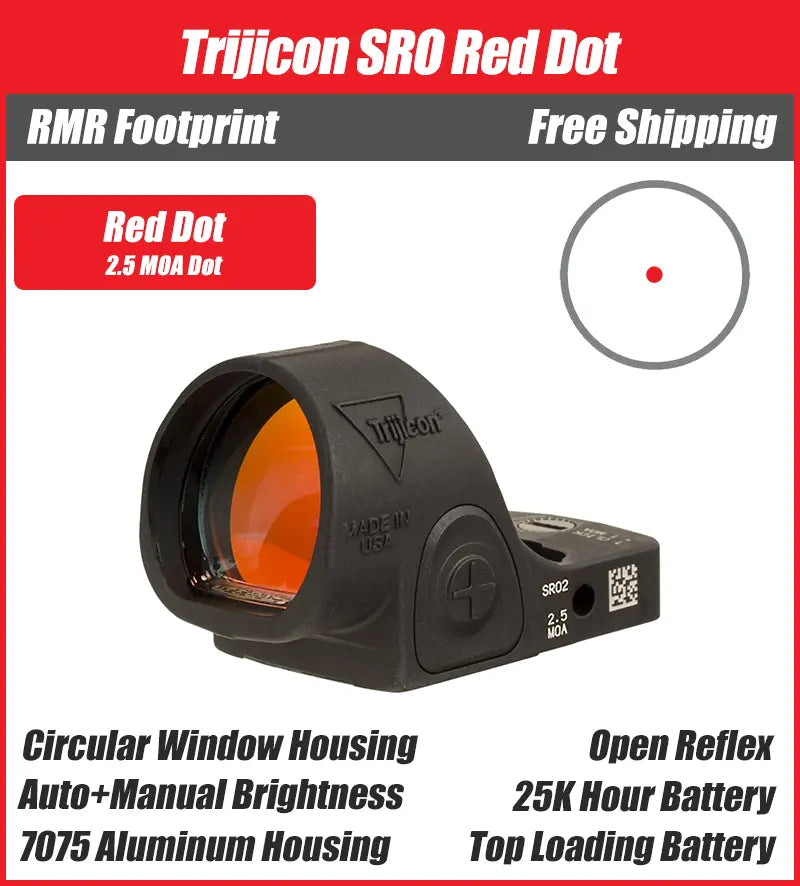
The Trijicon SRO, or Specialized Reflex Optic, was designed primarily for competition shooting and has become one of the most popular competition pistol optics available. It uses the standard RMR footprint but features a much larger, nearly circular window that makes the dot easier to find and track during recoil.
The SRO is available with red 1 MOA, 2.5 MOA, and 5 MOA dots. Trijicon now also offers a green 2.5 MOA version. All models provide automatic and manual brightness control with eight brightness settings, including two night vision settings and one super-bright setting.
A top-loading CR2032 battery can be replaced without removing the optic from the slide or disturbing its zero. Red-dot models provide approximately three years of battery life at brightness setting four, while the green 2.5 MOA model is rated for approximately two years at the same setting.
The SRO’s forged 7075-T6 aluminum housing weighs approximately 1.6 ounces. Its large window measures 0.98 × 0.89 inches, and the optic is waterproof to 3 meters. Although it can be used for concealed carry or duty, its large rounded housing does not redirect impacts as effectively as the RMR Type 2’s “owl ear” design. That does not mean the SRO is fragile, but it is more susceptible to damage from severe impacts than the duty-focused RMR models.
Although it shares the RMR footprint, the SRO’s window extends considerably farther forward. On certain pistols, this overhang can interfere with the slide or sit close to the ejection port. Its larger exterior can also affect holster compatibility, so physical clearance should be confirmed before selecting it.
Who is it for? The Trijicon SRO is best for competition shooters who prioritize a large, unobstructed window and want to track the dot more easily during recoil and rapid target transitions. It can still be used for carry or duty, but the RMR Type 2, RMR HD, or RCR is a better choice when maximum impact resistance is the priority.
Choosing between Red or Green Reticles
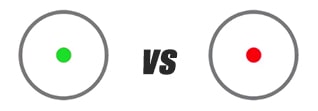
It’s f to go back and forth betweevn red vs green reticles, so here are a few practical points to help you decide which one makes the most sense for your setup.
- Green reticles are often easier on the eyes, especially during longer range sessions or extended training.
- Shooters with astigmatism sometimes see a cleaner dot in green. While results vary from person to person, many customers report that a green reticle appears more defined and less “smeared” compared to red.
- Green will not washout on backdrops like green grass, foliage, or green colors.
- In theory Green dots can have a longer battery life because Green is brighter, so for example a green dot on brightness setting 6 may be the same brightness as a red dot on setting 7 - which would save battery life.
If you want to learn more check out our full article about Red vs Green Dot Pros & Cons here.
Choosing between Open vs Closed Emitters
A simple way to think about open versus enclosed emitter red dots is to match the optic to how you plan to run your Glock MOS.
If your MOS is going to see a lot of outdoor use in rain, snow, or rough conditions, an enclosed emitter has a clear advantage. The emitter is sealed inside the housing, which helps prevent water, dirt, or debris from blocking the dot when conditions are less than ideal.
For shooters running OWB setups, whether for duty, range time, or general outdoor use, enclosed optics tend to be the safer choice for that added protection and consistency.
If your MOS is primarily carried IWB or used in more controlled environments, an open emitter optic will serve you just fine. They are lighter, simple, and still perform well in most situations, including light weather. Enclosed designs just add an extra layer of reliability when things get messy.
Maintenance is another factor to consider. Open emitter optics can collect dust, lint, and debris over time, especially with daily carry, so occasional cleaning is part of the routine. Enclosed emitters are easier to maintain since the critical components are protected inside the housing.
To learn more about Open vs Closed emitters you can check out our Open vs Closed Emitter Guide here.
How to decide which Trijicon reticle style is best for you
Trijicon pistol optics come in a variety of different reticle sizes. So it may be challenging to figure out which one is best. Below we will cover each size reticle they offer to help you decide which is best for you
For the comparisons we are grouping certain sizes together. For example 2.5 MOA and 3.25 MOA is so similar so we will group them into one bucket, the same goes for 5 MOA and 6.5 MOA.
 |
|
 |
|
 |
|
 |
|
 |
|
 |
|
Conclusion
Glock is obviously a proven platform, and pairing it with a Trijicon red dot gives you a dependable setup with a long history of duty and defensive use.
Whether you choose the classic RMR Type 2, the upgraded RMR HD, the enclosed RCR, or the competition-focused SRO, there is a Trijicon optic available for nearly every type of use. Just remember that each of these optics uses the RMR footprint, so you will need a Glock MOS-to-RMR adapter plate for installation.
If you still need help choosing an optic, adapter plate, or mounting hardware, reach out to our customer service team. We’ll be happy to help you find everything you need for your setup.