If you're looking for the biggest window possible on a competition pistol, you've probably narrowed your search to four optics: the Holosun 507 PROMAX, Holosun 507COMP, Vortex Defender XL and Trijicon SRO. While all four are built for speed, they each take a different approach to window size, reticle options, battery systems and overall shooting experience.
All four are designed to give the shooter a wide, unobstructed sight picture that makes it easier to find the reticle, track it through recoil and transition quickly between targets. However, they take noticeably different approaches.
The most important differences include:
- Window size and shape
- Reticle size and configuration
- Available reticle colors
- Battery life and battery access
- Mounting footprint
- Motion activation
- Solar assistance
- Weight
- Competition-specific features
In this guide, we will compare all four optics in detail and explain which type of shooter each one is best suited for.
|
Starts at $369.99 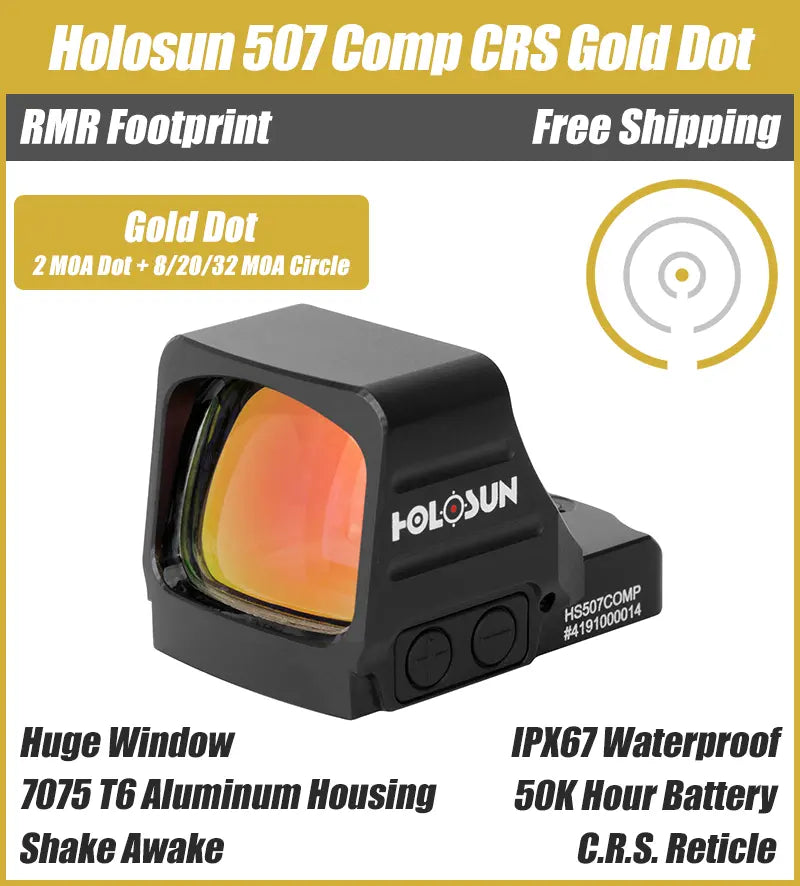
|
Starts at $399.99 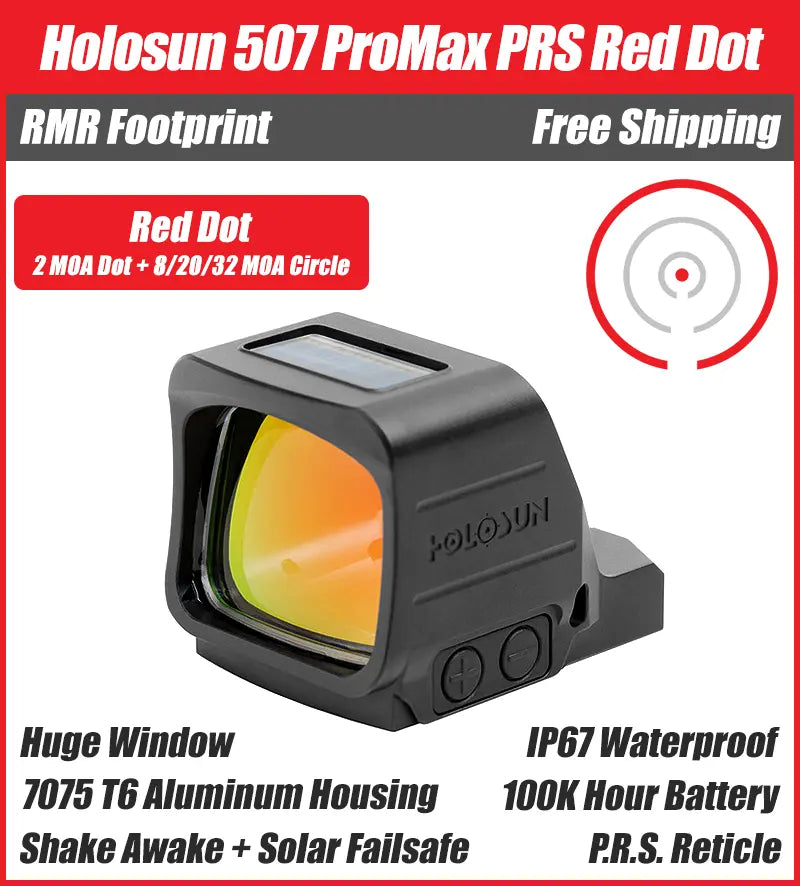
|
|
Starts at $399.99 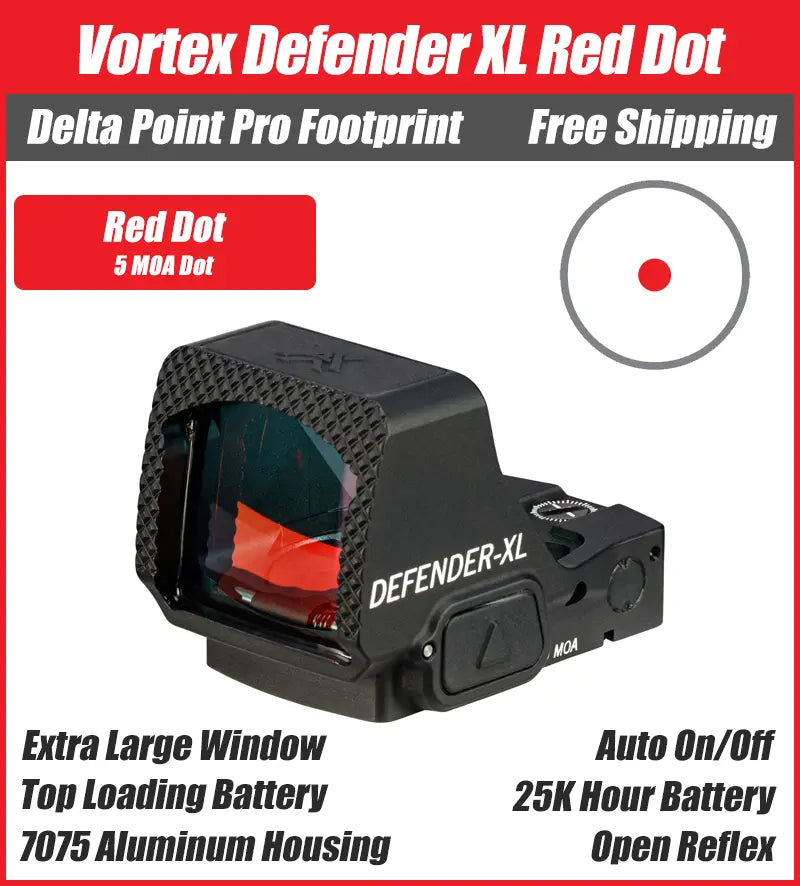
|
Starts at $585.00 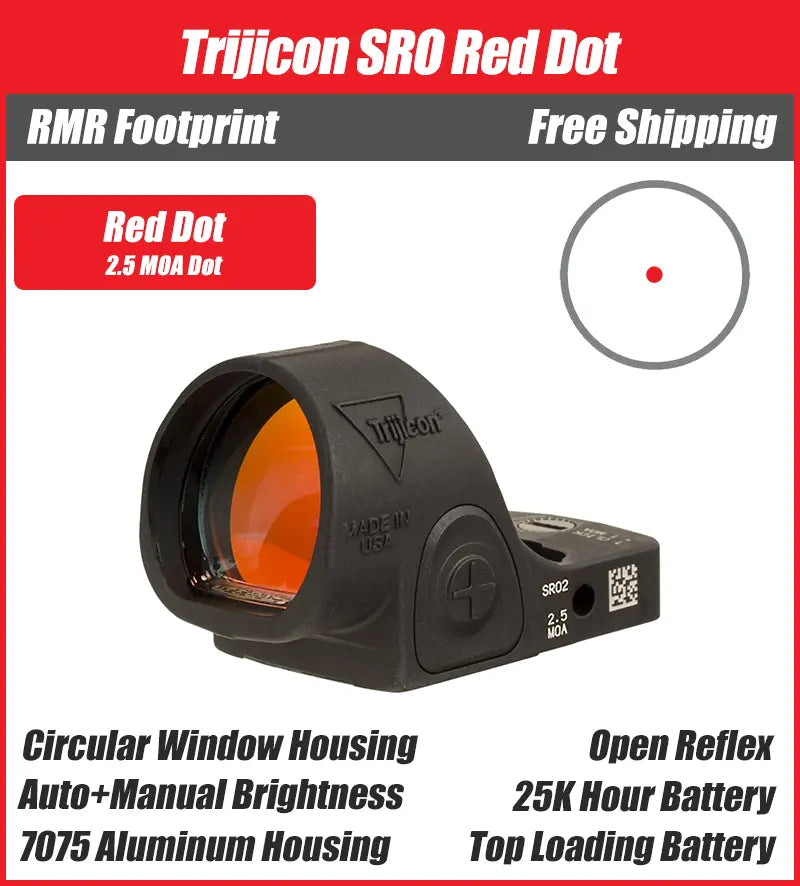
|
Quick Comparison
| Feature | Holosun 507 PROMAX | Holosun 507COMP | Vortex Defender XL | Trijicon SRO |
|---|---|---|---|---|
| Window Size | 1.18" × 0.98" | 1.10" × 0.87" | 1.00" × 0.92" | 0.98" × 0.89" |
| Reticle Options | 2 MOA dot with optional 8, 20 or 32 MOA circles | 2 MOA dot with optional 8, 20 or 32 MOA circles | 2, 5 or 8 MOA red dot; 3 MOA green dot | 1, 2.5 or 5 MOA red dot; 2.5 MOA green dot |
| Reticle Colors | Red, green or gold | Red, green or gold | Red or green | Red or green |
| Battery | CR1632 | CR1632 | CR2032 | CR2032 |
| Battery Access | Side tray | Side tray | Top loading | Top loading |
| Advertised Battery Life | Up to 50,000 hours | Up to 50,000 hours | Up to 25,000 hours |
Up to 25,000 hours
|
| Motion Activation | Yes | Yes | Yes | No |
| Solar | Yes | No | No | No |
| Automatic Brightness | Yes | No | No | No |
| Footprint | RMR | RMR | DeltaPoint Pro | RMR |
| Weight | 1.7 oz. | 1.7 oz. | 1.93 oz. | 1.6 oz. |
| Adjustment | 1 MOA per click | 1 MOA per click | 1 MOA per click | 1 MOA per click |
| Unique Feature | Largest window and solar assistance | Selectable reticles in a proven platform | Tall window, aspherical lens and Fast-Rack front | Rounded window and tool-less adjustments |
Battery-life claims are not directly interchangeable because manufacturers use different brightness settings and testing conditions. Holosun rates its listed runtime at setting six, while Trijicon rates the SRO at setting four under its specified testing conditions.

Why Window Size Matters in Competition
A larger window does not automatically make a shooter faster. With a perfect presentation, the reticle should appear near the center of almost any properly mounted pistol optic.
Competition shooting, however, rarely gives the shooter a perfect stance and presentation on every target.
You may be:
- Entering or leaving a shooting position
- Leaning around a barricade
- Shooting one-handed
- Moving laterally
- Transitioning aggressively between targets
- Recovering from an imperfect grip
- Shooting from an awkward body position
A larger window gives the shooter more room for error. When the pistol is slightly misaligned, there is a better chance that the reticle will still appear somewhere inside the window instead of becoming hidden behind the optic’s housing.
Window height can also help with tracking the reticle during recoil. As the slide cycles, the reticle moves vertically through the shooter’s sight picture. A taller window gives it more room to remain visible.
Window width may be helpful during aggressive side-to-side transitions. If the pistol moves slightly ahead of or behind the shooter’s eyes, a wider window gives the reticle more horizontal space before it disappears behind the housing.
Window size is important, but it is not the only factor. Window shape, lens clarity, edge distortion, housing thickness, deck height and reticle choice can all affect how large and usable an optic feels while shooting.
Which Optic Has the Largest Window?

Based on the published window measurements, the Holosun 507 PROMAX has the largest window in this comparison.
| Optic | Window Dimensions | Approximate Rectangular Area |
|---|---|---|
| Holosun 507 PROMAX | 1.18" × 0.98" | 1.156 sq. in. |
| Holosun 507COMP | 1.10" × 0.87" | 0.957 sq. in. |
| Vortex Defender XL | 1.00" × 0.92" | 0.921 sq. in. |
| Trijicon SRO | 0.98" × 0.89" | 0.872 sq. in. |
These area figures are calculated by multiplying the published width and height. They are useful for general comparison, but they do not represent the exact amount of usable glass.
The windows have different shapes, rounded corners and housing profiles. The SRO’s rounded window, in particular, cannot be perfectly represented by a simple rectangular calculation.
Window-Size Takeaways
The 507 PROMAX window is approximately:
- 7% wider than the 507COMP
- 13% taller than the 507COMP
- 21% larger by calculated rectangular area than the 507COMP
- 26% larger by calculated area than the Defender XL
- 33% larger by calculated area than the SRO
The Defender XL is approximately 9% narrower than the 507COMP, but it is about 5% taller.
That is an important distinction. The 507COMP provides more horizontal viewing space, while the Defender XL provides additional vertical room for following the dot through recoil.
The Defender XL and SRO are fairly close in measured size. However, their sight pictures feel different because the Defender XL uses a more squared window while the SRO uses a distinctive rounded profile.
Holosun 507 PROMAX

The Holosun 507 PROMAX takes the basic formula of the popular 507COMP and adds an even larger viewing window.
Its 1.18-by-0.98-inch window is the widest and tallest in this comparison. Based on the published dimensions, it provides approximately 21% more rectangular viewing area than the 507COMP.
That additional room may be especially helpful during aggressive target transitions, awkward shooting positions and rapid recoil recovery.
Performance Reticle System

The 507 PROMAX uses Holosun’s Performance Reticle System.
The shooter can select between:
- 2 MOA dot
- 2 MOA dot with an 8 MOA circle
- 2 MOA dot with a 20 MOA circle
- 2 MOA dot with a 32 MOA circle
This is one of the PROMAX’s biggest advantages.
A shooter who prefers a clean and precise aiming point can use the 2 MOA dot by itself. A shooter who wants a larger visual reference can add one of the circle options.
The 8 MOA circle provides a relatively compact aiming reference. The 20 and 32 MOA circles are much larger and may be easier to find during aggressive presentations or close, fast shooting.
The reticle system also lets the shooter experiment without buying another optic. You can test different reticles during practice and select the one that works best for your eyes and shooting style.
Red, Green and Gold Reticles
The PROMAX is available with red, green or gold illumination.
Reticle color is largely personal. Some shooters see green more clearly, while others prefer the contrast of red. Gold gives shooters another option if red and green do not appear as crisp to their eyes or against the backgrounds they commonly encounter.
Solar Failsafe

The PROMAX is the only optic in this comparison equipped with a solar panel.
Its Solar Failsafe system provides supplemental power and additional support as lighting conditions change. It gives the PROMAX an extra layer of power redundancy that the 507COMP, Defender XL and SRO do not offer.
It is important to distinguish this from the SRO’s traditional automatic-brightness system. The PROMAX is primarily operated through manually selected brightness settings, while the solar system assists with power and changing light conditions.
Forward Sunshade

The PROMAX also features an integrated forward-leaning sunshade.
This portion of the housing is intended to reduce glare and help preserve reticle clarity in bright outdoor environments. That could be useful during outdoor matches where the shooter moves between covered positions, shadows and targets illuminated by direct sunlight.
Battery and Controls
The PROMAX uses a side-loading CR1632 battery with an advertised runtime of up to 50,000 hours at setting six.
Because the battery tray comes out from the side, the optic does not need to be removed from the pistol during a battery change. That means the shooter can replace the battery without disturbing the optic’s mounting screws or potentially affecting zero.
It also includes:
- Shake Awake
- Automatic shutoff
- Memory
- Manual brightness adjustment
- Lockout mode
- Eight daylight settings
- Four night-vision settings
Lockout mode is particularly valuable for competition. Once the preferred reticle and brightness are selected, the controls can be locked to prevent accidental changes while handling the pistol, placing it on a table or moving it in and out of a case.
Construction and Mounting
The PROMAX uses a 7075-T6 aluminum housing and the RMR footprint.
It weighs 1.7 ounces and measures 1.8 inches long. Despite having the largest window in the comparison, it weighs the same as the smaller 507COMP.
The RMR footprint provides broad compatibility with optics-ready pistols, aftermarket slides and mounting plates.
Who Is the Holosun 507 PROMAX For?
The 507 PROMAX is best for the shooter who wants:
- The largest measured window in this comparison
- Multiple selectable reticles
- Red, green or gold illumination
- Solar assistance
- Motion activation
- An RMR footprint
- A side-loading battery
- A competition-focused sunshade
- Maximum features in one optic
It is the most feature-rich optic of the four.
Its biggest consideration is that it is newer than the 507COMP and SRO. Those older optics have already accumulated more long-term use across multiple competition seasons.
Holosun 507COMP

The Holosun 507COMP has become one of the most popular large-window competition optics because it combines a generous sight picture, selectable reticles and an RMR footprint in a relatively compact package.
Its 1.10-by-0.87-inch window is smaller than the PROMAX window, but it remains considerably larger than the windows found on traditional carry-oriented pistol optics.
Window Shape
The 507COMP has the second-largest calculated window area in this comparison.
It is wider than both the Defender XL and SRO, although it is slightly shorter than each of them.
That wider shape may appeal to shooters who value horizontal space during fast transitions between widely separated targets.
Compared with the Defender XL:
- The 507COMP is approximately 9% wider
- The Defender XL is approximately 5% taller
- The 507COMP has approximately 4% more calculated rectangular area
The difference in total area is fairly small, but the proportions are noticeably different.
Performance Reticle System

The 507COMP uses the same basic Performance Reticle System as the PROMAX:
- 2 MOA dot
- 2 MOA dot with an 8 MOA circle
- 2 MOA dot with a 20 MOA circle
- 2 MOA dot with a 32 MOA circle
This gives the shooter more reticle flexibility than the Defender XL or SRO.
The dot can be used alone for a clean sight picture, while the circle options provide a larger visual reference for fast shooting.
Some shooters find a large circle easier to locate during presentation and recoil. Other shooters find the extra information distracting, especially when shooting partial targets or small steel.
The advantage of the 507COMP is that the shooter can test both approaches with the same optic.
Reticle Colors
The 507COMP is available with red, green or gold illumination.
That gives it the same color flexibility as the PROMAX and more choices than either the Defender XL or SRO.
Battery and Electronics
The 507COMP uses a side-loading CR1632 battery with an advertised runtime of up to 50,000 hours at setting six.
It includes:
- Shake Awake
- Automatic shutoff
- Memory
- Manual brightness controls
- Lockout mode
- Eight daylight settings
- Four night-vision settings
Like the PROMAX, the side battery tray allows battery replacement without removing the optic.
The major electronic feature it lacks compared with the PROMAX is the solar system.
Construction and Mounting

The 507COMP is built from 7075-T6 aluminum and weighs 1.7 ounces.
It uses the RMR footprint, making it compatible with a wide selection of competition pistols, direct-milled slides and adapter plates.
Its body measures approximately 1.8 inches long, 1.3 inches wide and 1.3 inches tall.
It is also IP67 rated and listed for 5000G vibration resistance.
What About the Holosun 407COMP?

The Holosun 407COMP is nearly identical to the 507COMP in its general housing design, window size, footprint and basic controls.
The main difference is the reticle.
Instead of the selectable Performance Reticle System, the 407COMP uses a single 6 MOA dot.
That makes it a strong alternative for the shooter who likes the 507COMP window but prefers a simple, highly visible competition dot.
A 6 MOA dot sits between the 5 MOA options offered by Vortex and Trijicon and the Defender XL’s largest 8 MOA option.
Who Is the Holosun 507COMP For?
The 507COMP is best for the shooter who wants:
- A proven large-window competition optic
- Several selectable reticles
- Red, green or gold illumination
- An RMR footprint
- Motion activation
- A side-loading battery
- A wide viewing window
- Strong existing competition use and support
The 507COMP remains one of the safest all-around choices in this group. It offers most of the PROMAX’s reticle and electronic features in a slightly smaller package.
Vortex Defender XL

The Vortex Defender XL was designed around fast-paced pistol competition.
Its sight window measures 25.5 mm wide by 23.3 mm tall, which converts to approximately 1.00 inch wide by 0.92 inch tall.
That gives it a taller and more squared window than the Holosun 507COMP, although the 507COMP remains wider.
Window Shape
The Defender XL’s proportions are one of its most important features.
The 507COMP provides more horizontal room, but the Defender XL gives the shooter additional vertical space. That may help keep the dot visible as the slide rises and returns during recoil.
Its calculated rectangular area is approximately:
- 4% smaller than the 507COMP
- 6% larger than the SRO
- 20% smaller than the PROMAX
These percentages do not tell the entire story because window shape and housing thickness affect how the sight picture feels.
The Defender XL has a more squared appearance than the round SRO and a taller profile than the 507COMP.
Fixed Dot Options
Unlike the two Holosuns, the Defender XL does not have a selectable multi-reticle system.
Each version comes with one fixed dot size.

The red Defender XL is available with:
- 2 MOA dot
- 5 MOA dot
- 8 MOA dot
The green version is available with:
- 3 MOA dot
The 8 MOA Defender XL has the largest fixed dot offered by any of the four optics in this comparison.
A larger dot can be easier to see during recoil and rapid transitions. It provides a bold aiming point that may be especially useful on close targets.
The tradeoff is that a larger dot covers more of the target. Shooters who frequently engage small steel, partial targets or difficult long-range shots may prefer the 2 or 3 MOA options.
The 5 MOA version offers a middle ground between speed and precision.
Aspherical Lens
The Defender XL uses an aspherical lens designed to provide a distortion-free sight picture and more natural color reproduction.
That matters because window size alone does not determine optical quality. A large window with heavy distortion around the edges may feel less usable than a slightly smaller window with a cleaner image.
The aspherical lens is intended to keep the sight picture clear across the large viewing area.
ShockShield Polymer Insert

Vortex incorporates a ShockShield polymer insert into the optic.
The insert is designed to help protect the optic from impacts and hard use. This gives the Defender XL an additional protective feature that is not found in the same form on the other optics in this comparison.
Fast-Rack Texturing

The front of the Defender XL has aggressive Fast-Rack texturing.
This textured surface allows the shooter to catch the optic against a belt, table or other hard surface when manually cycling the slide.
That feature is unlikely to affect normal stage performance, but it can be useful during malfunction-clearing practice or one-handed manipulation drills.
Battery and Motion Activation
The Defender XL uses a top-loading CR2032 battery with an advertised runtime of up to 25,000 hours.
The top battery compartment allows the battery to be changed without removing the optic or disturbing zero.
Its motion-activation system automatically turns the optic on when movement is detected. A 10-minute automatic shutoff helps conserve battery life when the pistol is not moving.
The optic also includes a button lockout to prevent accidental brightness changes.
Brightness Settings
The Defender XL has 10 daylight-bright settings.
Its lowest two settings are night-vision compatible.
Unlike the SRO, it does not provide an automatic-brightness mode. The shooter selects the desired brightness manually and can lock the controls.
DeltaPoint Pro Footprint

The Defender XL is the only optic in this comparison that uses the DeltaPoint Pro footprint.
The 507 PROMAX, 507COMP and SRO all use the RMR footprint.
The DPP footprint can be an advantage when the pistol is already cut for that mounting pattern. If the pistol uses an RMR cut, the Defender XL will require a compatible adapter plate.
Neither footprint is automatically better in every situation. The best choice is normally the one that mounts securely and as low as possible on the individual pistol.
The Defender XL has a listed deck height of 10 mm. Deck height can influence how high the optic sits above the slide, which may affect presentation, iron-sight compatibility and the mounting plate required.
Weight
The Defender XL weighs 1.93 ounces, making it the heaviest optic in this comparison.
It is:
- 0.23 ounces heavier than either Holosun
- 0.33 ounces heavier than the SRO
For most pistols, that difference will be minor.
On a heavily tuned competition pistol, however, additional reciprocating slide weight can affect cycling speed and reliability. Shooters using reduced-power ammunition or lightweight recoil springs should test the pistol after changing optics.
Who Is the Vortex Defender XL For?
The Defender XL is best for the shooter who wants:
- A tall, squared competition window
- A simple fixed dot
- A large 5 or 8 MOA dot option
- A top-loading CR2032 battery
- Motion activation
- An aspherical lens
- Additional impact protection
- Fast-Rack slide manipulation
- A DeltaPoint Pro footprint
It is especially attractive for shooters who want one large, clean dot without a selectable circle system.
Trijicon SRO

The Trijicon SRO is one of the optics that helped define the modern large-window competition red-dot category.
SRO stands for Specialized Reflex Optic. Trijicon specifically designed it for pistol use, target shooting and competition.
Unlike the more squared Holosun and Vortex designs, the SRO uses a distinctive rounded, almost spherical window profile.
Rounded Window
The SRO window measures 0.98 inch wide by 0.89 inch tall.
Based strictly on width multiplied by height, it has the smallest window area in this comparison. However, that calculation does not fully describe how the optic looks while shooting.
Its rounded upper housing creates a very open sight picture without pronounced upper corners. Some shooters feel that this makes the window appear less restrictive than its measurements suggest.
Others may prefer the wider rectangular shape of the Holosuns or the taller squared shape of the Defender XL.
Window shape is personal. Two optics with similar measurements can feel noticeably different once they are mounted and viewed at full presentation.
Fixed Dot Choices

The red SRO is available with:
- 1 MOA dot
- 2.5 MOA dot
- 5 MOA dot
A green SRO is available with:
- 2.5 MOA dot
The 1 MOA version has the smallest reticle in this comparison. It provides a very precise aiming point and covers less of the target during difficult shots.
The 5 MOA version is easier to see during recoil and rapid transitions.
The 2.5 MOA model sits between the two and provides a balanced option for competition, target shooting and general use.
Unlike the Holosuns, the SRO does not allow the shooter to switch reticles. The dot size is selected when the optic is purchased.
Trijicon identifies the 1 MOA model for precision and bullseye-style shooting, the 5 MOA model for fast close shooting and the 2.5 MOA model as a versatile competition and target-shooting option.
Automatic and Manual Brightness
The SRO provides both automatic and manual brightness control.
It has eight manual brightness settings, including:
- One super-bright setting
- Two night-vision settings
Its button lock-in mode holds the user-selected brightness setting indefinitely. This is especially useful for competition because the shooter can select the preferred brightness before a stage and prevent the optic from changing it.
Its button lock-out mode secures the automatic-brightness function.
The SRO is the only optic in this comparison with a traditional automatic-brightness mode.
No Motion Activation
Unlike the Holosun models and Defender XL, the SRO does not use motion activation.
It is designed to remain continuously powered rather than shutting down and reactivating when movement is detected.
For competition use, this is not necessarily a disadvantage. Many shooters prefer to turn their optic on before a match and leave it operating throughout the day.
However, shooters who specifically want Shake Awake or motion activation should consider one of the other three optics.
Battery Life and Access

The SRO uses a top-loading CR2032 battery.
Trijicon lists approximately:
- Three years of continuous use for the red LED models
- Two years of continuous use for the 2.5 MOA green model
Those ratings are based on operation at setting four under Trijicon’s stated testing conditions.
The top-loading compartment allows battery replacement without removing the optic.
Construction and Weight
The SRO uses a forged 7075-T6 aluminum housing and is waterproof to 10 feet.
At 1.6 ounces with the battery installed, it is the lightest optic in this comparison.
Its relatively low weight may appeal to shooters who are carefully managing slide mass on a tuned competition pistol.
RMR Footprint

The SRO uses the same mounting footprint as the Trijicon RMR.
That gives it broad compatibility with RMR-cut slides and mounting plates.
However, the SRO is 2.2 inches long and extends farther forward than the other optics in this comparison.
Trijicon specifically warns against mounting the SRO on a pistol when the front of the optic overhangs the chamber or breech face. Improper positioning could interfere with normal operation.
Shooters should verify ejection-port clearance on their specific pistol and mounting system before purchasing an SRO.
Who Is the Trijicon SRO For?
The SRO is best for the shooter who wants:
- A rounded, unobstructed sight picture
- A simple fixed dot
- A precise 1 MOA option
- A fast 5 MOA option
- A top-loading CR2032 battery
- Automatic brightness
- An RMR footprint
- The lightest optic in this comparison
- A long-established competition design
The SRO remains a strong choice for shooters who prefer a clean dot and a traditional competition-focused design without multiple reticle modes.
Comparing Reticle Options
Reticle preference can be just as important as window size.
Small Dots: 1 to 3 MOA
Smaller dots cover less of the target and can provide a more precise aiming reference for long shots, small steel and partial targets.
Options in this category include:
- 1 MOA Trijicon SRO
- 2 MOA Holosun 507 PROMAX
- 2 MOA Holosun 507COMP
- 2 MOA Vortex Defender XL
- 2.5 MOA Trijicon SRO
- 3 MOA green Defender XL
The disadvantage is that a smaller dot may be more difficult to locate during an imperfect presentation, particularly when the brightness is set too low.
A small dot can also appear larger to shooters with astigmatism, depending on how their eyes perceive the reticle.
Medium and Large Dots: 5 to 8 MOA
Larger dots are generally easier to find and follow during recoil.
Options include:
- 5 MOA Vortex Defender XL
- 5 MOA Trijicon SRO
- 6 MOA Holosun 407COMP
- 8 MOA Vortex Defender XL
The 8 MOA Defender XL provides the largest fixed dot in the comparison.
A larger dot does not make the pistol mechanically less accurate. It simply covers more of the target. That can make exact aiming confirmation more difficult on small or distant targets.
For close, fast stages, the increased visibility may be worth the tradeoff.
Circle Reticles
The 507 PROMAX and 507COMP are the only optics here with selectable circle reticles.
Their 8, 20 and 32 MOA circle options give the shooter a much larger visual reference than a traditional dot.
This can make the reticle easier to locate during presentation, movement and awkward shooting positions.
Some shooters love the larger circles. Others feel that they add unnecessary visual clutter.
The major advantage is flexibility. The shooter can test several configurations and return to the simple 2 MOA dot whenever desired.
Comparing Battery Systems
All four optics allow battery replacement without removing the optic.
The two Holosuns use side-loading CR1632 trays.
The Vortex and Trijicon use top-loading CR2032 batteries.
Side-Loading Battery Advantages
A side tray:
- Keeps the battery compartment away from the top of the optic
- Allows battery changes without removing the optic
- Keeps the optic’s zero and mounting screws undisturbed
The tradeoff is that the system uses a small removable tray and tray screw.
Top-Loading Battery Advantages
A top-loading battery:
- Can be accessed immediately from above
- Does not require removing the optic
- Uses the larger and very common CR2032 battery
- Eliminates a removable side tray
Both systems work well for competition.
Regardless of the manufacturer’s advertised runtime, competitors should replace batteries on a preventive schedule rather than waiting for the reticle to dim during a match.
Comparing Mounting Footprints
The Holosun 507 PROMAX, Holosun 507COMP and Trijicon SRO all use the RMR footprint.
The Vortex Defender XL uses the DeltaPoint Pro footprint.
RMR Footprint
The RMR pattern has extensive support among:
- Factory optics-ready pistols
- Aftermarket slides
- Competition mounting plates
- Frame-mounted optic systems
DeltaPoint Pro Footprint
The DPP pattern is also widely supported and may be the better choice when the pistol is already cut directly for that footprint.
The ideal setup is normally the one that securely mounts the optic as low as possible without introducing an unnecessary adapter stack.
Before choosing an optic, confirm:
- The pistol’s factory optic cut
- The required mounting plate
- The proper screw length
- The manufacturer’s torque specification
- Ejection-port clearance
- Iron-sight compatibility, if desired
A great optic can still become a poor setup if it requires an excessively tall or complicated mounting arrangement.
Does Optic Weight Matter?

The weight differences are relatively small:
| Optic | Weight |
|---|---|
| Trijicon SRO | 1.6 oz. |
| Holosun 507 PROMAX | 1.7 oz. |
| Holosun 507COMP | 1.7 oz. |
| Vortex Defender XL | 1.93 oz. |
For most factory pistols, the difference between 1.6 and 1.93 ounces will not be significant.
It can matter more on a heavily tuned competition gun.
The optic is mounted to the slide, so it becomes part of the pistol’s reciprocating mass. Changing that mass can affect slide speed, recoil-spring requirements and reliability with reduced-power competition ammunition.
After installing a new optic, competitors should verify reliability with the exact ammunition, recoil spring and magazine combination they intend to use during matches.
For most shooters, however, reticle preference, window shape and mounting compatibility will matter more than a few tenths of an ounce.
Open-Emitter Considerations
All four optics in this comparison are open-emitter designs.
An open emitter allows manufacturers to create a large, clear viewing window without placing the entire system inside an enclosed housing. That makes this design especially attractive for competition.
The tradeoff is that the emitter is exposed.
Heavy rain, mud, lint or debris could potentially block the light from reaching the lens. This is generally less concerning on a dedicated competition pistol than on an everyday-carry or duty pistol, but it is still worth understanding.
For a match gun that is regularly inspected and maintained, the large window and clean sight picture will usually be the more important advantages.
Which Large-Window Competition Red Dot Is Best?
There is no single winner for every shooter.
Each optic has a specific strength.
Best Overall Feature Set: Holosun 507 PROMAX
The PROMAX has:
- The largest measured window
- Multiple selectable reticles
- Three reticle colors
- Solar assistance
- Motion activation
- Side-loading battery access
- RMR compatibility
- An integrated sunshade
It is the best choice for the shooter who wants the largest window and the most technology in one optic.
Buy Holosun 507-PROMAX At The Best Price
Best Proven All-Around Choice: Holosun 507COMP
The 507COMP offers:
- A large, wide window
- Selectable reticles
- Red, green or gold illumination
- Motion activation
- Side-loading battery access
- An RMR footprint
- A proven competition track record
It remains one of the most balanced choices for shooters who want flexibility without moving to the larger PROMAX window.
Buy Holosun 507 Comp At The Best Price
Best for a Large, Simple Dot: Vortex Defender XL
The Defender XL offers:
- A tall, squared window
- 2, 5 or 8 MOA red-dot choices
- A 3 MOA green option
- An aspherical lens
- Motion activation
- Top-loading battery access
- ShockShield protection
- Fast-Rack texturing
It is especially well suited to shooters who prefer a single large dot and use a DeltaPoint Pro mounting system.
Buy Vortex Defender XL At The Best Price
Best Classic Competition Setup: Trijicon SRO
The SRO offers:
- A rounded and open sight picture
- 1, 2.5 and 5 MOA red-dot options
- A 2.5 MOA green option
- Automatic brightness
- Tool-less adjustments
- Top-loading battery access
- RMR compatibility
- The lightest body in the group
It remains an excellent choice for shooters who want a simple dot, established design and distinctive rounded window.
Buy Trijicon SRO At The Best Price
|
Starts at $369.99
|
Starts at $399.99
|
|
Starts at $399.99
|
Starts at $585.00
|
Final Thoughts
The Holosun 507 PROMAX, Holosun 507COMP, Vortex Defender XL and Trijicon SRO are all designed to solve the same basic problem: giving competition shooters more room to find and track the reticle.
The 507 PROMAX provides the largest measured window and the broadest feature set.
The 507COMP provides a slightly smaller but proven platform with the same flexible reticle system.
The Defender XL uses a taller window, simple fixed-dot choices and a competition-focused housing built around the DeltaPoint Pro footprint.
The SRO offers a rounded sight picture, simple dot choices, automatic brightness and one of the most established designs in competitive pistol shooting.
The final decision should come down to four questions:
- Which footprint works best on your pistol?
- Do you want a simple dot or selectable circle reticles?
- Do you prefer a wider window, a taller window or a rounded window?
- Which reticle size and color appear clearest to your eyes?
Specifications can narrow down the choices, but the best competition optic is ultimately the one that is easiest for you to present, track through recoil and use confidently under match pressure.