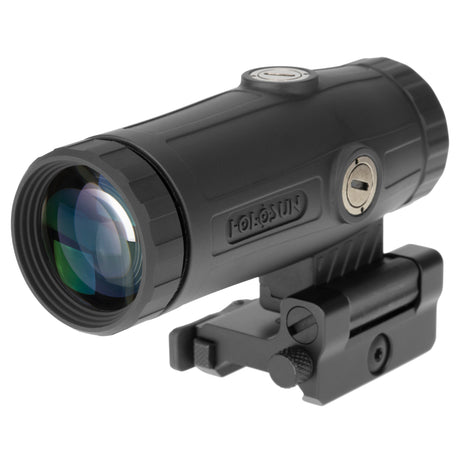
Holosun has been expanding its lineup of enclosed pistol red dots, and two of its newest options are the AEMS-MICRO and EPS CORE.
Both optics are designed to give shooters a larger viewing window without moving to a traditional full-size pistol optic. However, they take two very different approaches.
The AEMS-MICRO features a tall, square window inspired by Holosun's rifle-mounted AEMS series. The EPS CORE, on the other hand, uses the wider window found on the original full-size EPS but puts it on an optic with an RMSc mounting footprint. Then there's the original full-size EPS to think about as well.

So, which should you choose?
In this guide, we'll compare the AEMS-MICRO and EPS CORE, explain how they stack up against the original EPS, and help you decide which one makes the most sense for your pistol.
|
Starts at $369.99 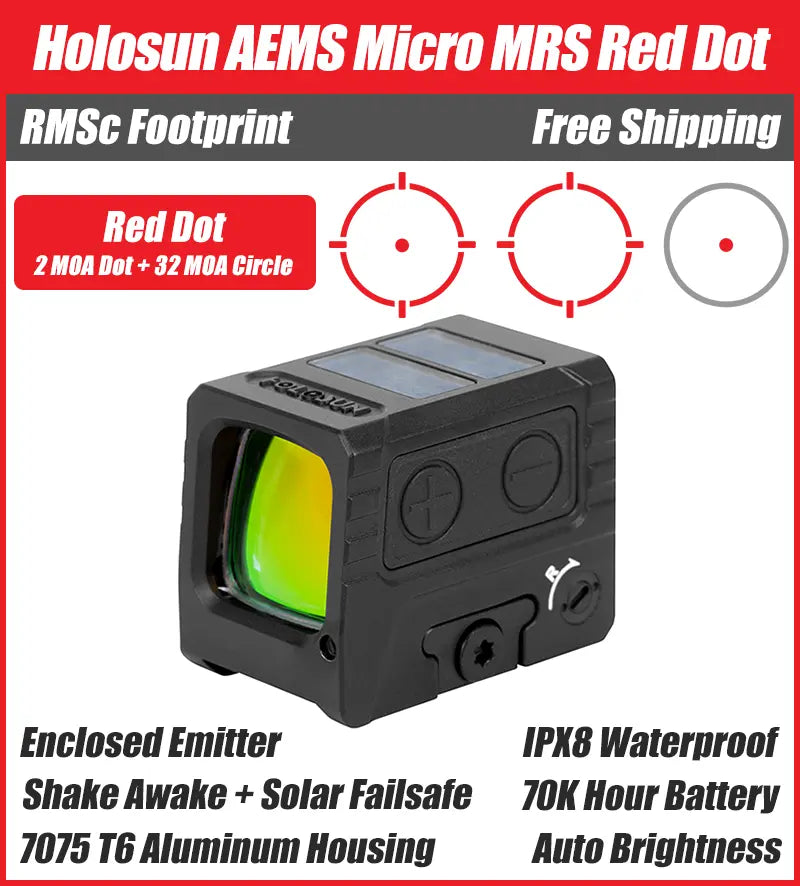
|
Starts at $229.99 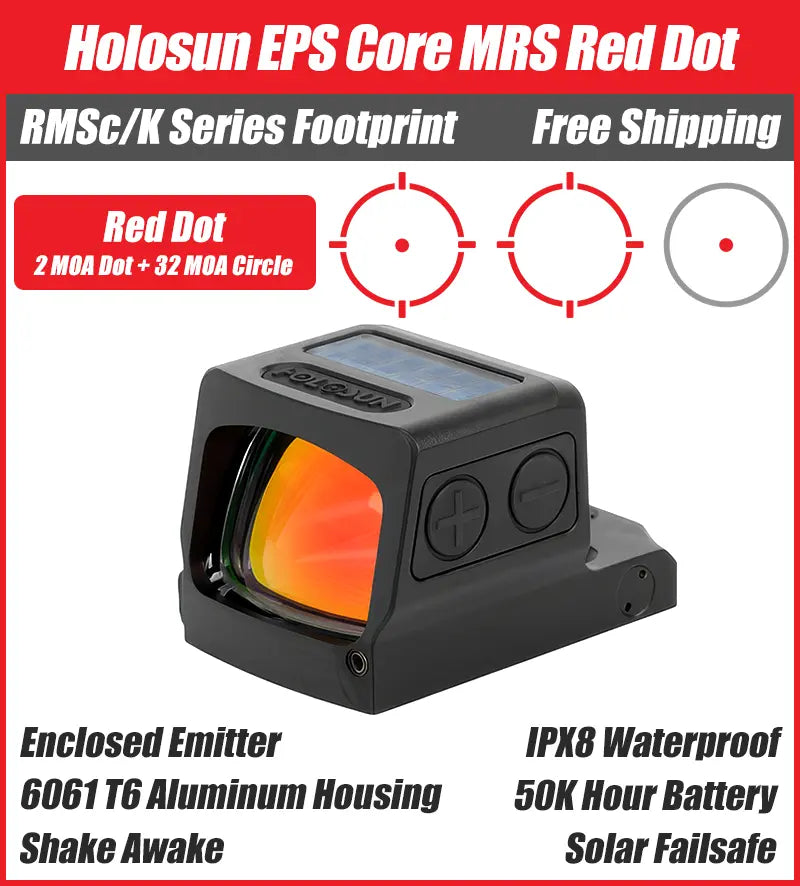
|
Starts at $329.99 
|
Holosun AEMS-MICRO vs EPS CORE vs EPS: Specifications
Let's start with a quick comparison of the three optics.
| Feature | AEMS-MICRO | EPS CORE | Full-Size EPS |
|---|---|---|---|
| Window Size | 0.71" × 0.71" | 0.90" × 0.63" | 0.90" × 0.63" |
| Window Shape | Square | Rectangular | Rectangular |
| Mounting Footprint | AEMS-MICRO (RMSc Adapter Included) |
RMSc | Holosun K |
| Weight | 2.1 oz | 1.4 oz | 1.4 oz |
| Dimensions | 1.5" × 1" × 1.2" | 1.61" × 1.18" × 0.97" | 1.63" × 1.19" × 0.99" |
| Battery | CR1620 | CR1620 | CR1620 |
| Battery Life | Up to 100,000 Hours | Up to 50,000 Hours | Up to 50,000 Hours |
| Reticle Options | 2 MOA Dot / 32 MOA Circle | 3 MOA Dot or MRS | 2 MOA, 6 MOA, or MRS |
| Reticle Colors | Red, Green, Gold | Red, Green, Gold | Red, Green, Gold |
| Solar Failsafe | Yes | MRS Models | MRS Models |
| Shake Awake | Yes | Yes | Yes |
| Housing | 7075-T6 Aluminum | 6061-T6 Aluminum | 7075-T6 Aluminum |
| Waterproof Rating | IPX8 | IPX8 | IPX8 |
Specifications vary by reticle configuration. EPS CORE MRS models use a 2 MOA dot and 32 MOA circle, while the dot-only CORE models use a 3 MOA dot.
As you can see, these three optics share many features. However, the differences in window shape, mounting footprint, and overall height can make a significant difference depending on your pistol.
AEMS-MICRO vs EPS CORE: Window Size Comparison

Both optics offer a relatively large viewing window for their mounting footprint, but they achieve that in different ways.
The AEMS-MICRO has a 0.71" × 0.71" window, giving it a distinctive square appearance.
The EPS CORE has a 0.90" × 0.63" window, which is the exact same size as the original full-size EPS.
That means the AEMS-MICRO has approximately 13% more vertical window height than the EPS CORE, while the EPS CORE has approximately 27% more window width.
Interestingly, despite the MICRO having a taller window, the EPS CORE actually has approximately 12% more total window area.
So which design is better?
Why Choose the Taller AEMS-MICRO Window?
One of the biggest advantages of a taller window is the additional vertical viewing space.
When you're shooting a pistol, the red dot moves within your sight picture as the slide cycles and the pistol recoils.
A taller window gives you more room to track that movement, potentially making it easier to keep the reticle visible and reacquire it between shots.
This is one of the things we really like about the AEMS-MICRO.
Rather than making the window extremely wide, Holosun designed it to provide additional height while keeping the overall optic relatively compact.
For shooters who frequently lose their dot during recoil, the additional vertical viewing area may be particularly appealing.
Why Choose the Wider EPS CORE Window?
The EPS CORE takes a more traditional approach, offering a wide rectangular window.
Its 0.90" window width gives you more horizontal viewing area than the AEMS-MICRO, which can be helpful when acquiring your dot or transitioning between targets.
The EPS CORE also has a lower-profile housing, which is another major advantage we'll discuss shortly.
Neither window shape is inherently better for every shooter. Some people prefer the additional vertical space of the AEMS-MICRO, while others prefer the wider, lower-profile design of the EPS CORE.
Ultimately, window shape is largely personal preference.
AEMS-MICRO vs EPS CORE: Mounting Footprint
What Footprint Does the AEMS-MICRO Use?

The AEMS-MICRO uses a proprietary mounting system. The optic itself has a modified Aimpoint ACRO-style footprint. Holosun also includes an RMSc-to-MICRO adapter plate with the optic. This allows the AEMS-MICRO to be installed on many pistols with an RMSc optic cut, including popular models like the Glock 43X MOS and Glock 48 MOS.
The included plate can also work with compatible Holosun K footprint slides, although mounting hardware and slide configuration should always be checked.
There is one important compatibility consideration.
Some pistol slides use raised threaded screw posts. On these slides, the included AEMS-MICRO plate may not provide enough clearance for the mounting screws, preventing proper installation.
We're currently working on a thicker AEMS-MICRO adapter plate designed to address this issue. If your pistol has raised threaded posts, we recommend checking compatibility before ordering the AEMS-MICRO.
What Footprint Does the EPS CORE Use?

The EPS CORE uses a true RMSc footprint, meaning it can mount directly to many RMSc-cut slides without requiring an additional adapter plate.
This is a major advantage for owners of slimline pistols.
For example, if you have a Glock 43X MOS or Glock 48 MOS, the EPS CORE is designed to work directly with that RMSc mounting pattern.
It can also work with compatible Holosun K-pattern cuts, provided the slide geometry and mounting hardware are appropriate.
The biggest difference between the EPS CORE and AEMS-MICRO is that the CORE doesn't require a separate adapter for a compatible RMSc slide.
That keeps the mounting setup simpler and helps the optic sit lower.
AEMS-MICRO vs EPS CORE: Optic Height and Co-Witness
Another significant difference between these optics is how high they sit above the pistol slide.
The AEMS-MICRO has a noticeably taller housing than the EPS CORE.
Between its square window design and the included adapter plate, the AEMS-MICRO places the viewing window higher above the slide.
This isn't necessarily a bad thing. The additional height is part of what makes the MICRO appealing to shooters who want a larger vertical viewing area.
However, it does affect your ability to co-witness with iron sights.

The AEMS-MICRO generally isn't going to co-witness with factory-height iron sights, and shooters who want an iron sight co-witness will likely need taller sights.
The EPS CORE takes the opposite approach.
Because it mounts directly to compatible RMSc slides and features a lower-profile housing, it keeps the optic closer to the slide.
Depending on your pistol and iron sight configuration, this can make it easier to retain a usable co-witness with factory-height sights.
The original EPS also benefits from a relatively low optical deck, although co-witness compatibility depends on the slide and mounting system.
For concealed carry shooters who want to preserve their factory iron sights, the EPS CORE has a meaningful advantage over the AEMS-MICRO.
AEMS-MICRO vs EPS CORE: Battery Life and Features
Despite their differences in size and mounting systems, these optics share quite a few features.
Battery Life and Shake Awake
The AEMS-MICRO has an advertised battery life of up to 100,000 hours, while the EPS CORE and original EPS are rated for up to 50,000 hours.
That's twice the advertised battery life for the AEMS-MICRO.
All three optics use side-loading CR1620 batteries, allowing you to replace the battery without removing the optic and potentially losing your zero.
They also feature Holosun's Shake Awake technology, which conserves battery power by deactivating the reticle after a period of inactivity and reactivating it when motion is detected.
Actual battery life depends on the brightness setting, reticle configuration, and operating conditions.
Solar Failsafe and Automatic Brightness

The AEMS-MICRO includes Solar Failsafe and automatic brightness adjustment using a forward-facing light sensor. The forward-facing light sensor helps the optic respond to lighting conditions in the direction you're aiming, which can be especially useful when transitioning between differently lit environments.
The EPS CORE MRS models offer similar Solar Failsafe functionality and a forward-facing light sensor.
However, it's important to distinguish between the EPS CORE variants.
The EPS CORE 3 MOA dot-only models do not include Solar Failsafe, while the MRS versions do.

The 3 MOA models still include automatic brightness adjustment through a forward-facing light sensor.
The original EPS also offers Solar Failsafe on its MRS configurations.
For shoppers comparing these optics, make sure you're looking at the specific reticle version rather than assuming every variant has identical features.
Reticle Options

The AEMS-MICRO comes equipped with Holosun's Multi-Reticle System.
You can select between a 2 MOA dot, 32 MOA circle, or combined circle-dot reticle.

The EPS CORE is available in two main configurations: a simple 3 MOA dot or an MRS version with a 2 MOA dot and 32 MOA circle.
The original full-size EPS has additional options, including 2 MOA dot, 6 MOA dot, and Multi-Reticle System configurations.

Both the AEMS-MICRO and EPS CORE are available with red, green, or gold reticles.
Housing Material and Durability
Another difference worth mentioning is the housing material.
The AEMS-MICRO uses 7075-T6 aluminum, while the EPS CORE uses 6061-T6 aluminum.
The original full-size EPS also uses 7075-T6 aluminum.
7075 aluminum is generally stronger than 6061 aluminum, giving the AEMS-MICRO and original EPS an advantage in material strength.
However, 6061 aluminum is still a durable material and is widely used in optic housings.
All three optics feature enclosed emitters, hard-anodized finishes, and IPX8 waterproof ratings.
For most shooters, the EPS CORE should still offer plenty of durability for normal concealed carry and range use.
Who Should Buy the Holosun AEMS-MICRO?

The AEMS-MICRO is our pick for shooters who want a taller window and prioritize tracking the dot during recoil.
Its square window is what really sets it apart from the EPS series.
We particularly like the idea of the MICRO on compact concealed carry pistols where shooters want more vertical viewing area than traditional micro optics provide.
The tradeoff is that it's taller, heavier, and requires an adapter plate.
If keeping your optic as low-profile as possible is your priority, the MICRO probably isn't the best choice.
Choose the AEMS-MICRO if you:
- Want a tall, square viewing window.
- Prioritize vertical reticle tracking during recoil.
- Prefer the AEMS styling and window design.
- Want up to 100,000 hours of advertised battery life.
- Don't mind a taller optic or using an adapter plate.
Who Should Buy the Holosun EPS CORE?

The EPS CORE is our pick for shooters who want a large window on a compact pistol without adding unnecessary height.
We think Holosun made a great decision by combining the full-size EPS window with a true RMSc mounting footprint.
This gives shooters an option that sits between the smaller EPS Carry and taller optics like the AEMS-MICRO.
Its wider window provides plenty of viewing area, while the low-profile design makes it attractive for concealed carry.

We also like that the EPS CORE offers both a basic 3 MOA dot option and a more feature-rich MRS model.
Choose the EPS CORE if you:
- Want a full-size EPS viewing window on an RMSc-cut pistol.
- Prefer a wider, rectangular viewing window.
- Want a low-profile enclosed red dot.
- Prefer direct mounting without an additional adapter.
- Want a lighter optic for concealed carry.
- Want to maximize the possibility of co-witnessing with factory-height iron sights.
Who Should Buy the Original Full-Size EPS?

The original EPS remains an excellent option, especially for shooters who already have a Holosun K footprint mounting system.
In fact, because the EPS CORE and original EPS have identical window dimensions, there isn't a window-size advantage to either one.
The original EPS does offer a stronger 7075-T6 aluminum housing and a wider range of reticle configurations.
For shooters who already own an EPS, there probably isn't much reason to switch to an EPS CORE unless the mounting footprint itself is a significant advantage.
Choose the full-size EPS if you:
- Already have a K footprint slide or adapter plate.
- Want a 7075 aluminum housing.
- Prefer the traditional EPS design.
- Want more reticle configuration options.
- Don't need the EPS CORE's native RMSc mounting interface.
|
Starts at $369.99
|
Starts at $229.99
|
Starts at $329.99
|
Final Thoughts: AEMS-MICRO vs EPS CORE
The Holosun AEMS-MICRO and EPS CORE are both excellent additions to Holosun's enclosed pistol optic lineup, but they offer very different advantages.
The AEMS-MICRO prioritizes a tall, square window that gives shooters additional vertical viewing area. It also features a rugged 7075 aluminum housing, Solar Failsafe, and impressive advertised battery life.
The EPS CORE takes a more traditional approach, offering a wider window in a lighter, lower-profile housing with a true RMSc footprint.
And if you're wondering where the original EPS fits into the picture, remember that the EPS CORE and full-size EPS have the same viewing window. The main differences are their mounting footprints, housing materials, and reticle configurations.
For concealed carry, we'd lean toward the EPS CORE for shooters who want a low-profile optic with a larger window.
However, if your priority is getting as much vertical viewing area as possible to help track your dot during recoil, the AEMS-MICRO is definitely worth considering.
Ultimately, the best choice comes down to your pistol, mounting footprint, and personal preference.
If you're unsure which Holosun optic will fit your handgun, reach out to our customer service team at Freedom Gorilla. We're always happy to help you find the right red dot and mounting solution.