Holosun is taking rifle optics to another level with two new products: the ARO-EVO-DUAL and AEMS-EVO-DUAL.
Both optics take an existing Holosun red dot and integrate two additional aiming systems directly into the housing: a visible green laser and an infrared (IR) laser.
But what makes these new EVO-DUAL models especially exciting isn't just having three aiming systems in one unit. It's how they work together.
Both feature Holosun's new Tri-Channel Zeroing System, which allows all three aiming systems to be zeroed together. And when you compare the price against buying a red dot and a separate Holosun IRIS-GR2 laser device, there's some serious value here.
Let's break down what makes these EVO-DUAL optics special, how they compare to the IRIS-GR2, and the differences between the ARO-EVO-DUAL and AEMS-EVO-DUAL.
|
Starts at $499.99 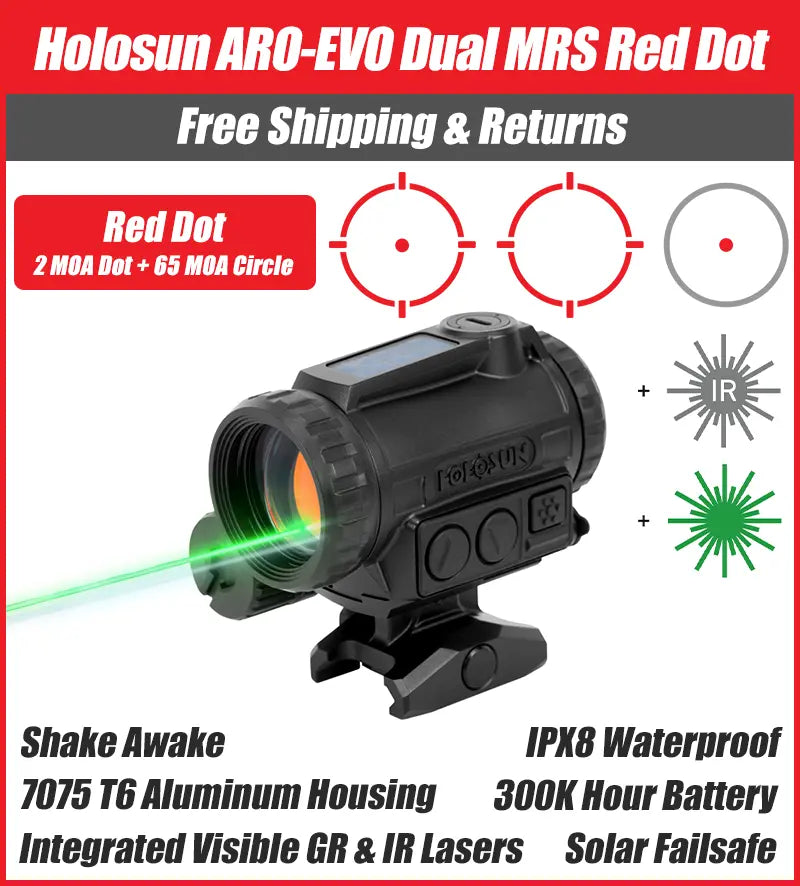
|
Starts at $699.99 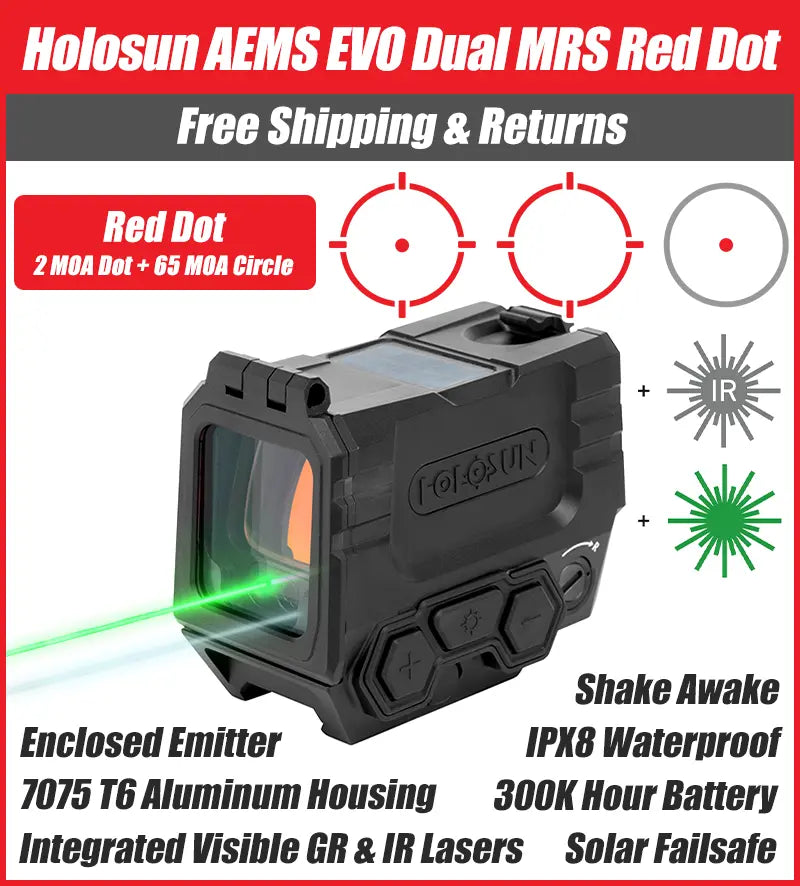
|
What Makes an Optic an EVO-DUAL?
The easiest way to understand Holosun's new EVO-DUAL series is to start with the standard EVO optics.
The ARO-EVO and AEMS-EVO are already excellent enclosed rifle red dots, featuring larger viewing windows, Solar Failsafe, Shake Awake, and more.
Now, Holosun has taken those same platforms and added two integrated lasers:
- Red Dot: A traditional red Multi-Reticle System (MRS) for aiming through the optic.
- Visible Green Laser: A 520nm green laser for daytime and low-light use.
- Infrared Laser: An 850nm IR laser designed for use with night vision equipment.
Instead of purchasing and mounting a separate laser aiming device, everything is integrated directly into the optic.
This creates a more streamlined rifle setup, saves valuable Picatinny rail space, and eliminates the need for additional laser mounting hardware.
And there's one more huge advantage.
Tri-Channel Zeroing: Zero Your Red Dot and Both Lasers Together
This is easily one of our favorite features of the new EVO-DUAL optics.
Normally, if you're running a red dot alongside a separate visible/IR laser aiming device, you have to zero your red dot and then separately adjust your laser system. Holosun's Tri-Channel Zeroing System changes that. Both the ARO-EVO-DUAL and AEMS-EVO-DUAL use a coaxial alignment system that connects the zeroing adjustments of all three aiming channels.
When you zero your red dot reticle, the visible green laser and IR laser track with those same adjustments.
That means you can zero your red dot like normal, and the two integrated lasers are aligned through the same adjustment system rather than requiring separate zeroing procedures. For anyone who's ever dealt with multiple aiming devices on the same rifle, that's a pretty big deal.
It simplifies setup, reduces the number of adjustments you need to make, and makes managing multiple aiming systems considerably easier.
As always, we recommend verifying your zero and laser alignment at your intended shooting distance.
It's Basically an IRIS-GR2 Built Into Your Red Dot
Here's another way to think about the new EVO-DUAL models...
Holosun already makes the IRIS-GR2, a standalone laser aiming device that combines a visible green laser and an infrared laser into one compact unit. But with the new EVO-DUAL lineup, Holosun has essentially taken that same concept and integrated it into an ARO-EVO or AEMS-EVO. And the laser specifications are the same.
| Laser Specification | IRIS-GR2 | EVO-DUAL Models |
|---|---|---|
| Visible Laser Color | Green | Green |
| Green Laser Wavelength | 520nm | 520nm |
| Green Laser Power | Under 5mW | Under 5mW |
| Green Laser Class | Class 3R | Class 3R |
| IR Laser Wavelength | 800–880nm | 850nm |
| IR Laser Power | Under 0.7mW | Under 0.7mW |
| IR Laser Class | Class 1 | Class 1 |
| Battery | CR123A | CR123A |
As you can see, the EVO-DUAL models offer the same advertised visible and IR laser output specifications as the standalone IRIS-GR2. The IRIS-GR2 just has an IR wavelength range of 800–880nm, while both EVO-DUAL models specify 850nm, which falls within that range.
The EVO-DUAL Also Includes a Dual-Button Pressure Pad
Another great feature is that both EVO-DUAL optics include a dual-button Crane-plug remote pressure switch.
This pressure pad allows you to conveniently control the integrated laser functions without having to reach up and manipulate the optic itself. The dual-button setup gives you convenient remote laser activation, while the included cable management helps keep your rifle setup clean.
For comparison, the standalone IRIS-GR2 includes a single-button Crane-plug pressure pad.
Between the integrated lasers, unified zeroing system, and included remote switch, Holosun has put together a very convenient all-in-one package.
EVO-DUAL Pricing: You Actually Save Money
This might be the best part. Normally, when a manufacturer combines multiple features into a single product, you expect to pay a premium for that convenience. However, both EVO-DUAL models actually cost a lot less than purchasing their standard red dot counterparts and an IRIS-GR2 separately.
Here's how the pricing breaks down.
ARO-EVO-DUAL Price Comparison
| Setup | Price |
|---|---|
| ARO-EVO-SPR Red Dot | $269.99 |
| IRIS-GR2 Green/IR Laser | $499.99 |
| Total Purchased Separately | $769.98 |
| ARO-EVO-DUAL | $499.99 |
| Your Savings | $269.99 |
The ARO-EVO-DUAL costs the same $499.99 as the standalone IRIS-GR2! You're essentially getting the red dot built into the laser system without paying more than you would for the IRIS-GR2 alone.
And the savings are similar with the AEMS-EVO-DUAL.
AEMS-EVO-DUAL Price Comparison
| Setup | Price |
|---|---|
| AEMS-EVO Red Dot | $429.99 |
| IRIS-GR2 Green/IR Laser | $499.99 |
| Total Purchased Separately | $929.98 |
| AEMS-EVO-DUAL | $699.99 |
| Your Savings | $229.99 |
Not only are you saving over $200 either way, but you're also getting the benefits of having everything integrated into one optic. That means fewer separate accessories, less rail space occupied, and a much simpler zeroing system.
One additional detail worth mentioning: the standard $269.99 ARO-EVO-SPR-RD used in this price comparison has a SPR reticle, while the ARO-EVO-DUAL includes Holosun's selectable Multi-Reticle System.
Pricing reflects the models and configurations listed above and is subject to change.
ARO-EVO-DUAL vs AEMS-EVO-DUAL: What's the Difference?
Now that we've covered what makes these products special, let's compare the two models.
Both optics use the same integrated visible and IR laser systems, Tri-Channel Zeroing technology, and CR123A battery platform.
The biggest differences come down to window size, optic design, weight, and a few additional features.
1. Window Size and Optic Design
The most noticeable difference is the viewing window.
The ARO-EVO-DUAL features a circular 26mm (1.02-inch) window, following Holosun's traditional compact tube-style rifle optic design.
The AEMS-EVO-DUAL features a larger rectangular 1.26" × 0.98" window.
The AEMS design provides a wider viewing area, which many shooters prefer for maintaining situational awareness and acquiring the reticle quickly.
The ARO-EVO-DUAL, on the other hand, offers a more traditional tube-style sight picture with a slightly smaller overall body.
Neither design is necessarily better for everyone. It largely comes down to the viewing window and optic style you prefer.
2. Size and Weight
As expected, the ARO-EVO-DUAL is the smaller and lighter optic.
| Specification | ARO-EVO-DUAL | AEMS-EVO-DUAL |
|---|---|---|
| Window Size | 1.02" Diameter | 1.26" × 0.98" |
| Body Dimensions | 2.68" × 1.77" × 2.60" | 3.03" × 2.00" × 2.68" |
| Body Weight | 8.15 oz | 10.6 oz |
| Optical Centerline Height | 1.63" | 1.63" |
The ARO-EVO-DUAL has a 2.45 oz advantage in listed body weight. Both have the same 1.63-inch optical centerline height.
If keeping your optic compact and lightweight is the priority, the ARO-EVO-DUAL has the advantage.
If a larger viewing window matters more, the AEMS-EVO-DUAL may justify the additional size and weight.
3. Anti-Reflective Device (ARD)
Another nice addition to the AEMS-EVO-DUAL is its anti-reflective device, commonly called an ARD.
An ARD helps reduce reflections from the front lens, which can be beneficial when using your optic in bright outdoor conditions. It's a useful accessory, especially for shooters who want to minimize noticeable reflections from their optic.
What Features Do Both EVO-DUAL Optics Share?
Despite their differences, these two optics actually share all the normal Holosun optic features everyone knows and loves.
Both include:
- Red Multi-Reticle System (MRS): Select between a 2 MOA dot, 65 MOA circle, or combined circle-dot.
- Visible Green Laser: 520nm, Class 3R, under 5mW.
- IR Laser: 850nm, Class 1, under 0.7mW.
- Tri-Channel Zeroing: Shared red dot, visible laser, and IR laser adjustment system.
- Dual-Button Crane-Plug Pressure Pad: Included remote activation for the laser functions.
- Solar Failsafe: Solar backup for the red dot reticle.
- Shake Awake: Motion-activated technology to help conserve battery life.
- Automatic Brightness Adjustment: Forward-facing light sensing adjusts the reticle based on lighting conditions.
- Night Vision Compatibility: Eight daylight and four night-vision brightness settings.
- CR123A Battery: Side-loading battery compartment powering the optic and laser systems.
- IPX8 Waterproof Rating: Designed to withstand demanding environmental conditions.
- 1000G Vibration Resistance: Rugged construction for rifle applications.
Both optics also have identical advertised battery-life specifications:
| Function | Advertised Battery Life |
|---|---|
| Red Dot Only at Setting 6 | Up to 300,000 Hours |
| Visible Green Laser | 12 Hours |
| IR Laser | 50 Hours |
These are Holosun's published figures, and actual runtime will depend on operating conditions and usage.
Importantly, both EVO-DUAL models are currently offered exclusively with a red Multi-Reticle System. Unlike some other EVO optics, there are no green or gold reticle variants listed for the DUAL models.
Which EVO-DUAL Should You Buy?
The good news is that you're getting the same core technology regardless of which model you choose.
Both optics combine a red dot, green laser, and IR laser into one housing. Both offer Tri-Channel Zeroing, and both eliminate the need for a separate laser aiming module.
The decision really comes down to which optic design you prefer and how much you want to spend.
Choose the ARO-EVO-DUAL If...
You want the most affordable way to get all three aiming systems in one optic.
At $499.99, the ARO-EVO-DUAL is an incredible value considering it costs the same as a standalone IRIS-GR2.
It's also the more compact and lightweight choice, making it a great fit for shooters who prefer a traditional tube-style optic.
Choose the AEMS-EVO-DUAL If...
You prefer a larger, rectangular viewing window and don't mind spending an additional $200.
At $699.99, you're getting the same impressive laser technology in an optic with a more expansive sight picture.
The larger window and additional features make it appealing to shooters who already prefer the AEMS platform.
|
Starts at $499.99
|
Starts at $699.99
|
Final Thoughts: Holosun's EVO-DUAL Optics Are a Big Step Forward
What makes the ARO-EVO-DUAL and AEMS-EVO-DUAL so interesting isn't simply that Holosun managed to squeeze two lasers into a red dot.
It's how they've integrated everything together.
You get three aiming systems, one streamlined optic, and one shared zeroing system.
You don't need a separate IRIS-GR2 taking up additional rail space, and you're actually saving money compared to purchasing the optic and laser module separately.
The ARO-EVO-DUAL brings all that functionality to the table for $499.99, while the AEMS-EVO-DUAL offers a larger viewing window and additional features for $699.99.
For shooters looking to build a rifle with both visible and night-vision laser capability, these are two of Holosun's most interesting new optics.
Three aiming systems. One optic. One zero.
And that's what makes the EVO-DUAL lineup so exciting.
Have questions about the ARO-EVO-DUAL or AEMS-EVO-DUAL, or need help choosing the right optic for your rifle? Contact our customer service team. We're happy to help.