If you are shopping for a compact Osight red dot, the Osight K and Osight SE can look very similar at first. They use the same RMSc footprint, have the same window size, use the same battery and share many of the same core features.
The real decision comes down to three things: open emitter versus enclosed emitter, reticle options and price.
In this guide, we will explain everything the two optics have in common, where they differ and which one makes the most sense for your concealed carry pistol.
|
Starts at $159.99 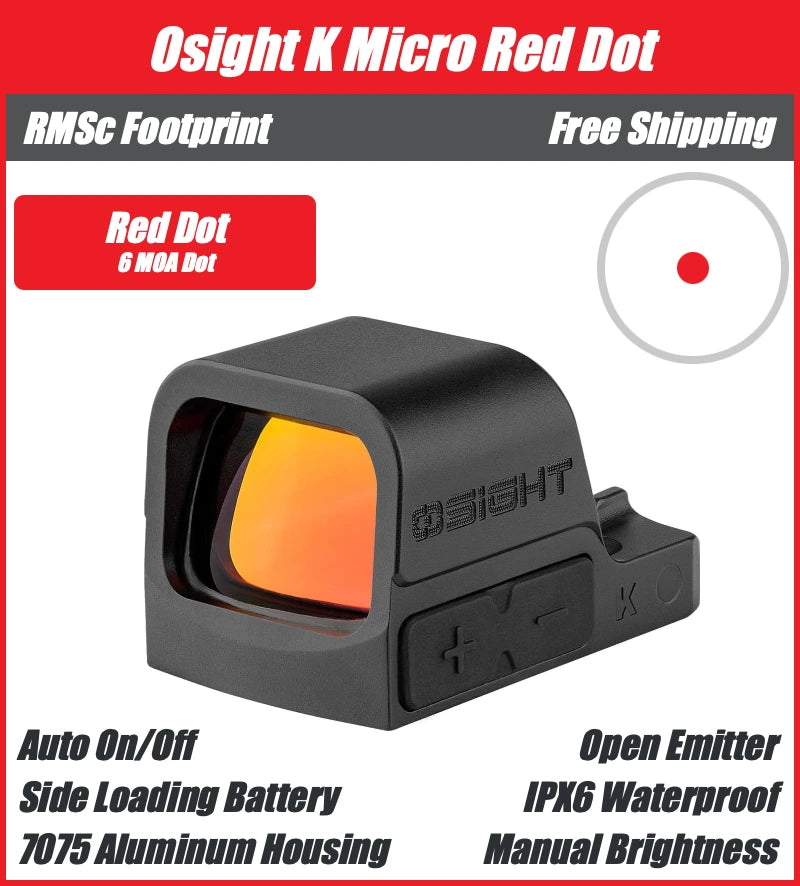
|
Starts at $179.99 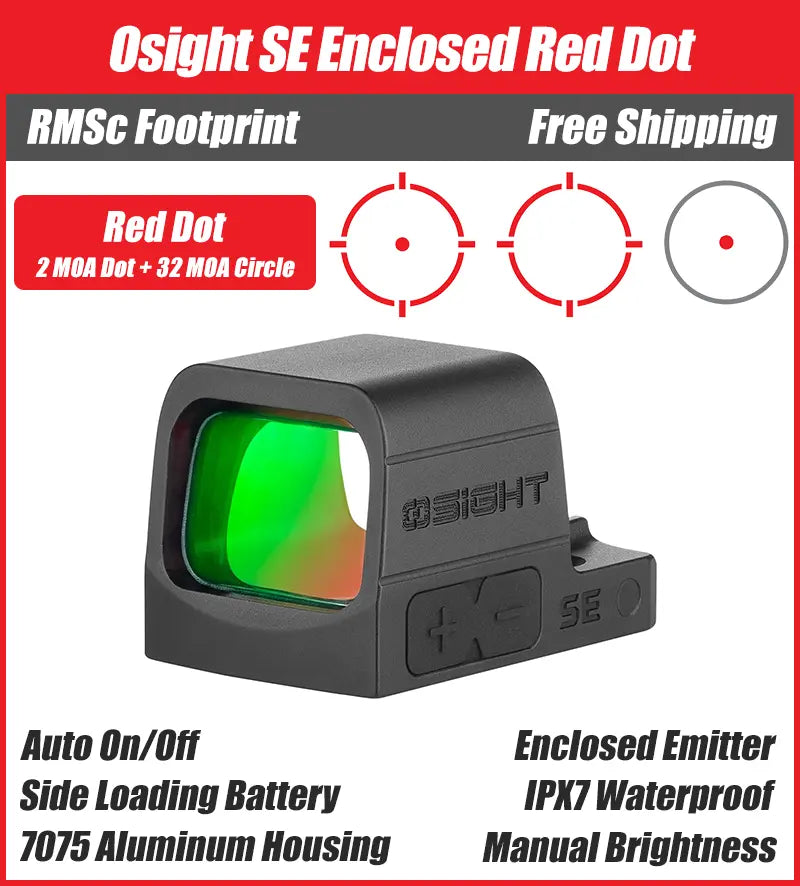
|
Osight K vs. Osight SE: Quick Comparison
| Feature | Osight K | Osight SE |
|---|---|---|
| Emitter Design | Open emitter | Enclosed emitter |
| Footprint | RMSc | RMSc |
| Reticle Options | 6 MOA dot | 6 MOA dot or 2 MOA dot and 32 MOA circle MRS |
| Reticle Colors | Red or green | Red or green |
| Window Size | 0.83 × 0.55 in. | 0.83 × 0.55 in. |
| Housing Material | 7075-T6 aluminum | 7075 aluminum |
| Battery | Side-loading CR1620 | Side-loading CR1620 |
| Brightness Settings | 8 daylight and 2 night vision | 8 daylight and 2 night vision |
| Motion Sensor | Yes | Yes |
| Maximum Runtime | Up to 71,000 hours | Up to 75,000 hours with dot only |
| Waterproof Rating | IPX6 | IPX7 |
| Weight | 1.02 oz. | 0.97 oz. |
| Starting Price | $160 | $180 |

What Do the Osight K and Osight SE Have in Common?
Despite the difference in emitter design, these two optics share most of their basic platform.
Both use an RMSc footprint, making them suitable for many optics-ready concealed carry pistols. Depending on the handgun's optic cut, they may mount directly or require the correct adapter plate and screws.
They also have the exact same 0.83 × 0.55-inch window size. Moving from the K to the SE does not mean giving up viewing area.
Both optics also include:
- A strong 7075 aluminum housing
- A side-loading CR1620 battery that can be changed without removing the optic
- Eight daylight brightness settings and two night vision settings
- Motion activation to wake the optic when movement is detected
- 1 MOA windage and elevation adjustments
- A ±35 MOA windage and elevation adjustment range
- Red and green reticle choices
Their physical dimensions are nearly identical as well. Both are 1.59 inches long and 0.98 inches wide. The K is 0.98 inches tall, while the SE is 0.97 inches tall.
In other words, fitment, size, window and basic operation are not the deciding factors. The choice is really about how much emitter protection and reticle flexibility you want, and how much you want to spend.
Open Emitter vs. Enclosed Emitter

The biggest difference between the Osight K and Osight SE is their emitter design.
The Osight K is an open-emitter optic. Its LED emitter projects the dot onto the lens, but the space between the emitter and lens is open. This is the traditional pistol-red-dot design and has been used successfully for concealed carry, training, competition and home defense for years.
The Osight SE is an enclosed-emitter optic. Its emitter is completely sealed inside the housing between two lenses. Dirt, lint, rain and other debris cannot enter the optic and block the emitter’s path to the rear lens.
Why Does That Matter for Concealed Carry?
A concealed carry optic spends its day close to your body and underneath clothing. Over time, lint, dust and other debris can collect inside an open-emitter optic. Rain, sweat or mud can also interfere with the emitter if the pistol is exposed to harsher conditions.
If something blocks the emitter, the dot may appear distorted or disappear until the obstruction is removed. An enclosed optic prevents that particular problem because the emitter system is sealed.
That does not mean an open-emitter optic is a poor choice for concealed carry. Open emitters are good enough for most people, especially when the pistol is carried in a quality holster and the optic is inspected and cleaned periodically. Plenty of dependable carry optics use this design.
An enclosed emitter simply adds another layer of protection and requires less attention to the area around the emitter. Its exterior lenses can still collect dust, water or fingerprints, but debris cannot get inside and interrupt the projected dot.
For normal everyday carry, either design can work well. If you regularly work outdoors, carry in dirty or wet environments, or simply want the most protected design available, the SE has the advantage.
Reticle Options
The next major difference is the reticle.
Osight K: 6 MOA Dot

The Osight K keeps things simple with a 6 MOA dot, available in red or green.
A 6 MOA dot is a strong choice for a compact concealed carry pistol. The larger dot is easy to find during the draw and provides a simple, uncluttered aiming point at typical defensive handgun distances. It gives up some fine precision compared with a smaller dot, but that is rarely a major concern for the K’s intended use.
The K name also places the optic in the same general compact-pistol category made familiar by Holosun’s K-series optics, especially the 407K with its 6 MOA dot.
Osight SE: 6 MOA Dot or Multi-Reticle System

The Osight SE is also available with a 6 MOA dot in red or green. If you like the K’s simple reticle but want the protection of an enclosed emitter, this version gives you exactly that.
The SE is also available with Osight’s Multi-Reticle System, or MRS. This version gives you three selectable reticle modes:
- A precise 2 MOA dot
- A large 32 MOA circle
- The 2 MOA dot and 32 MOA circle together
The circle-dot combination is larger and can be easier to locate quickly, especially for newer red-dot shooters who sometimes struggle to find a small dot during the presentation. The 2 MOA dot-only mode provides a finer aiming point when you want more precision.
If you already know that you prefer a bold, simple dot, either optic’s 6 MOA version will make sense. If you prefer a circle-dot system, the SE MRS is the better choice.
Price Difference
The Osight K is the more affordable optic, while the Osight SE’s enclosed housing and additional reticle choices increase the price.
| Model | Reticle | Color | Price |
|---|---|---|---|
| Osight K | 6 MOA dot | Red | $160 |
| Osight K | 6 MOA dot | Green | $170 |
| Osight SE | 6 MOA dot | Red | $180 |
| Osight SE | 6 MOA dot | Green | $200 |
| Osight SE MRS | 2 MOA dot and 32 MOA circle | Red | $200 |
| Osight SE MRS | 2 MOA dot and 32 MOA circle | Green | $220 |
When comparing matching 6 MOA models, the red SE costs $20 more than the red K, while the green SE costs $30 more than the green K. That extra money primarily buys the enclosed-emitter design and its IPX7 waterproof rating.
The MRS versions cost more again, but they add the selectable 2 MOA dot and 32 MOA circle reticle system.
Other Small Differences
Although the emitter, reticle and price are the three differences that matter most, there are a few smaller specification changes.
The Osight K has an IPX6 waterproof rating, while the SE is rated IPX7. The K has a maximum advertised runtime of up to 71,000 hours at brightness setting 3. The SE is rated for up to 75,000 hours at setting 3 when using the dot-only reticle.
Who Should Buy the Osight K?

The Osight K is the better choice if you:
- Want the most affordable option
- Prefer a simple 6 MOA dot
- Want a red or green reticle
- Do not mind inspecting and cleaning an open emitter occasionally
- Carry in relatively normal everyday conditions
- Want a compact alternative in the same general category as a Holosun 407K
For most concealed carry users, the K provides the important features without making you pay for an enclosed design you may not need. You still get a 7075 aluminum housing, side-loading battery, motion activation and a 6 MOA dot.
Who Should Buy the Osight SE?

The Osight SE is the better choice if you:
- Want an enclosed emitter for additional protection
- Carry around dirt, dust, moisture or other debris
- Prefer the lower-maintenance option for daily carry
- Want a selectable 2 MOA dot and 32 MOA circle reticle
- Want the stronger IPX7 waterproof rating
- Do not mind paying a little more for those upgrades
The SE also makes sense for someone who likes everything about the K but wants an enclosed optic. Choosing the 6 MOA SE gives you the same basic dot style and window size with a sealed emitter system.
|
Starts at $159.99
|
Starts at $179.99
|
Final Thoughts: Osight K or Osight SE?
The Osight K and Osight SE have more in common than their names might suggest. Both are compact RMSc optics with 7075 aluminum housings, identical window sizes, side-loading batteries, motion activation and red or green reticle options.
The Osight K is the straightforward value option. It gives you a bright 6 MOA dot and the core features most concealed carry users need, starting at $160. Its open-emitter design is perfectly adequate for most shooters who perform basic inspection and cleaning.
The Osight SE costs more, but it gives you a fully enclosed emitter and the option of either a 6 MOA dot or a versatile multi-reticle system. It is the better fit for harsher conditions, buyers who want the added peace of mind of a sealed optic, or shooters who prefer a circle-dot reticle.
Neither is automatically the right answer for everyone. If you value simplicity and price, choose the K. If you value maximum protection or more reticle choices, choose the SE.
If you are still not sure which optic is right for your handgun or need help confirming fitment, contact our customer service team. We will be happy to help you choose the correct optic, plate and screws for your setup.