Hey Freedom Gorillas, in this article we will be comparing two budget rifle red dot optics, the Holosun ARO vs. the Sig Romeo 5 Gen II. We’ll discuss the main specifications as well as how both compare to each other. At the same time, we will touch on the newer Holosun ARO-EVO.
Let’s get into it.
TLDR
Both the Holosun ARO and Sig Romeo 5 Gen II are budget red dot rifle optics, however, the Holosun ARO offers more options. The Sig Romeo 5 comes in a red or green optic with a 2 MOA dot. The Holosun ARO comes with a red, green, or gold optic and has the option of a 2 MOA dot or MRS (2 MOA and 65 MOA circle).

The battery life on both optics can range up to 50k hours, but since the Holosun ARO has a MRS option, the battery life on this optic can be diminished based on the reticle setting. The Sig Romeo 5 Gen II is a slightly more affordable option, coming in at $159.99 for the green dot and $149.99 for the red dot while the Holosun ARO comes in at $169.99 for the 2 MOA green dot and $159.99 for the 2 MOA red dot.
One main difference between the two optics is aperture size; the Holosun ARO has a larger aperture size at 22mm while the Sig Romeo 5 has a 20 mm aperture. Mount height is also different. The Sig Romeo 5 uses an absolute cowitness sight of 1.4” and the Holosun ARO has a 1.63” ⅓ co witness mount and comes with an absolute co-witness mount. In addition, the Holosun ARO has more height and the battery tray is beneath the optic, adding to the distance between the optic and rail.
The housing of both optics are made of similar material (high-grade aluminum), come in black, are similar in size, have controls on the top, and have a similar waterproof rating; although the Holosun ARO has a higher submersion threshold with IPX8 as opposed to the Romeo 5’s IPX7 rating.
Both the Sig Romeo 5 and Holosun ARO use an auto off and auto off feature that turns it off after a period of inactivity and back one when it detects motion, however, the ARO provides more options (10 mins, 1 hour, 12 hours, or OFF vs. 2 mins or OFF). Both have the same brightness settings, are T2 compatible, and have an optional magnification addition.
|
Starts at $159.99 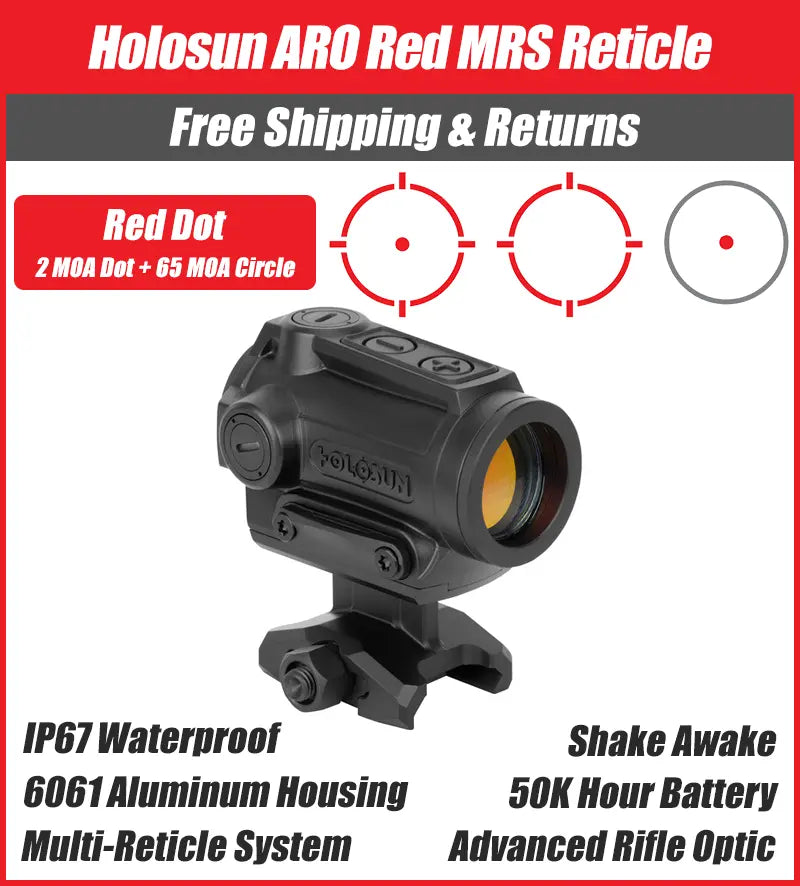
|
Starts at $149.99 
|
Sig Romeo 5 Main Specs |
Holosun ARO Main Specs |
The Sig Romeo 5 Gen II is a new step in the Sig Romeo 5 optic and has these main specifications: perfect for users with astigmatism. |
The Holosun ARO (Advanced Rifle Optic) serves as an evolution of the 403 and 503 series with a sleeker design and more features. Here are the main specifications for this rifle optic: |
Curious about how the ARO improved on Holosun's earlier models? Check out our article on saying goodbye to the 403 and meeting Holosun's new ARO red dots to see what changed and why the ARO is worth the upgrade.
Footprint for Fitment
Both the Holosun ARO and the Sig Romeo 5 Gen II have a T2 compatible footprint which are designed to clamp onto a 1913 Picatinny Rail. Both have a clamping design, however the Sig Romeo 5 requires a torx to clamp onto the rail while the ARO uses a standard bolt that can be adjusted with a wrench.
When it comes to the Sig Romeo 5 vs. Holosun ARO, both optics fit the same rifles and both come with the appropriate tool needed to tighten the optic to the rail, however, the ARO can be taken off by hand since it uses a bolt.
Reticle System

When it comes to the Sig Romeo 5 vs. Holosun ARO, one of the biggest differences comes down to the options in the reticle system. For the Sig Romeo 5 Gen II you have your choice of a red or green dot reticle and only has a 2 MOA Dot option.
On the other hand, the Holosun ARO comes with a red, green, or gold reticle option and has the choice of a 2 MOA dot or a MRS with a 2 MOA dot and 65 MOA circle. This gives you the option to choose between only the 2 MOA dot, only the 65 MOA circle, or the 2 MOA dot and 65 MOA circle at the same time.
Height and Deck Height
One of the major differences to consider when it comes to the Sig Romeo 5 vs. Holosun ARO is the overall height of both optics and the mount, which can affect the co-witnessing on an AR platform. The Romeo 5 comes with an absolute co-witness mount at around 1.4” while the Holosun comes with a 1.63” lower ⅓ co-witness mount as well as an absolute co-witness mount.
This makes co witnessing slightly different between the two sights and really comes down to preference. That being said, the Holosun is also taller at 2.63” and the Sig comes closer to the rail at 2.42”.

Battery and Battery Life
Something to consider when discussing the height of the optics is the position of the battery. The Holosun ARO uses a side-access battery tray, which makes the battery easy to access and replace even when mounted on a rifle. However, it does add more space underneath the optic, adding more height than the Sig.
The Sig Romeo 5 has the battery mounted laterally in a cap, which adds some bulk to the side, but doesn’t add height as with the Holosun ARO. The battery is also easily accessible when mounted on a rifle.
The main difference batterywise when it comes to the Sig Romeo 5 vs. Holosun ARO is how you access the battery. With the ARO, you will need a torx to open up the battery tray while the Sig needs a simple flat thin edge to undo, even a finger nail can help to access the battery.
Both optics use 1 CR2023 battery.
Battery Life
For both the Sig Romeo 5 and the Holosun ARO, the battery life is reported to be up to 50k hours. This is dependent on the settings. With the Sig Romeo 5, Sig reports that the battery life is around 40k hours, but users do report that it can last up to 50k hours.
Since the Holosun ARO comes with an MRS option, the range can vary depending on the settings of the brightness in combination with the reticle choice. Some users report that on brightness setting 6 with both circle and dot reticle, battery life can go as low as 20k hours.
MOTAC and Shake Awake
Both the Sig Romeo 5 and Holosun ARO have a feature that turns the optic off after a set time of inactivity, and can then be reactivated after the optics sense motion.
The Sig Romeo 5 Gen II uses the MOTAC (Motion Activated) system which automatically turns the optic off after 2 minutes of inactivity and turns the optic back on when it senses motion. This cannot be adjusted to a different time but the feature can be disabled.
The Shake Awake on the Holosun ARO has four different options to choose from. It can turn off after 10 minutes (default), 1 hour, or 12 hours of inactivity, or it can be disabled completely, keeping your optic on until you manually turn it off. When Shake Awake is activated, you simply need to move your optic to reactivate; it will turn on with your last used brightness setting.
Composition and Material
The Holosun ARO housing is made of Durable Aluminum and has an IPX8 waterproof rating which means it hasn’t been tested for protection against solids but it is protected against continuous immersion in water.
Sig doesn’t disclose what type of aluminum the Sig Romeo 5 Gen II housing is made of, but it is an aircraft-grade aluminum with an anodized finish. It is also waterproof rated at IPX7, so it also hasn’t been tested for solids but is protected against immersion in up to 1 meter of water.
Both optics are manufactured in China.
Brightness Settings
For the Sig Romeo 5 vs. Holosun ARO in terms of brightness settings, you’re not going to find much of a difference. Both have 12 brightness settings, 10 of which are for daylight, and 2 are night vision compatible.
The brightness settings for each optic are adjustable from buttons on the top of the optic.
Magnification Option
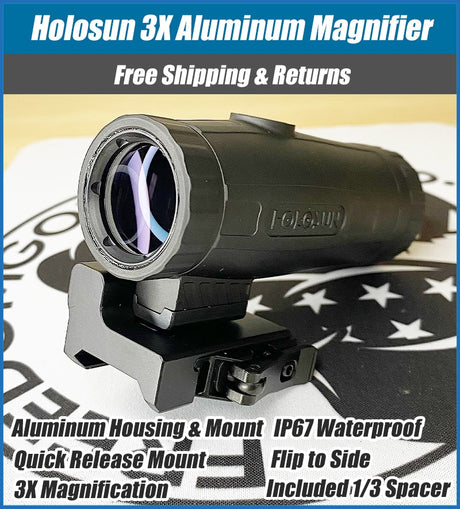
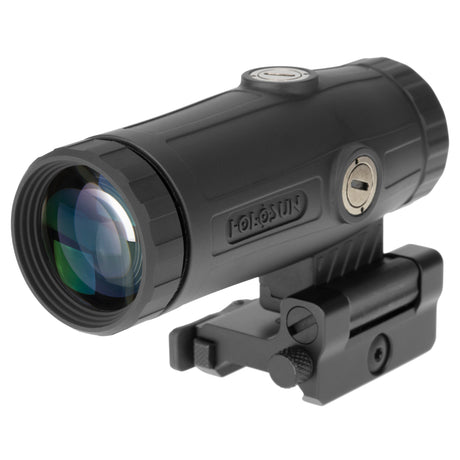
What is a Romeo without his Juliet? Both optics also come with a magnification addition: The Sig Romeo 5 is intended to be coupled with its magnifying counterpart, the Juliet, and the Holosun ARO with the HM3X. These can be bought as an ensemble or separately, but any magnifier will work.
Which One Do I Buy?
So, when it comes to the Sig Romeo 5 vs. Holosun ARO, which optic is for you? As always, this comes down to preference. So let’s take a look at a simple breakdown of the price, similarities, and differences.
Price
Both optics are budget rifle optics, and come in at an affordable price, but the Sig Romeo 5 is the more affordable option:
Sig Romeo 5 Gen II:
- Sig Sauer Romeo 5 Gen II 2 MOA Red Dot: $149.99
- Sig Sauer Romeo 5 Gen II 2 MOA Green Dot: $159.99
- Romeo 5 Gen II and Juliet3-Micro Combo Kit (Sig Website): $299.99
Holosun ARO:
- Holosun ARO 2 MOA Red Dot: $159.99
- Holosun ARO 2 MOA Green Dot: $169.99
- Holosun ARO 2 MOA Gold Dot: $159.99
- Holosun ARO 2 MOA Red Dot (FDE): $169.99
- Holosun ARO 2 MOA Red Dot (Brown): $169.99
- Holosun ARO M.R.S. Red Dot: $199.99
- Holosun ARO M.R.S. Green Dot: $209.99
- Holosun ARO M.R.S. Gold Dot: $199.99
- Holosun ARO Red 2 MOA Red Dot + HM3X Combo Kit with Hard Case: $339.99
Similarities
- Both have a T2-style footprint and can attach easily to a 1913 Picatinny rail.
- Both have the same number of brightness settings: 10 Daytime and 2 Night Vision compatible
- Both are manufactured in China
- Both are red dot rifle optics
- Both have an auto shut off feature
- Both are made of high-grade aluminum
Differences
- The Holosun ARO comes with the option of a red, green, or gold dot and is available with a 2 MOA dot or MRS (2 MOA dot and 65 MOA circle) while the SIg Romeo 5 is available in red or green but only with a 2 MOA dot option.
- Battery tray for ARO and side cap for Romeo 5. Battery tray underneath red sight of ARO increases the height slightly
- Different mount heights: Romeo 5 is 1.4 (cowitness mount) ARO is 1.63
- Romeo 5 uses torx that can’t be taken off by hand ARO Hex with wrench and can be taken off by hand
- The button system is different; the ARO is a simple tap system while the Romeo 5 requires you to hold the button down to turn it on and off and make adjustments
- The Holosun ARO models are slightly more expensive than
- The Holosun ARO has Shake Awake technology that has four different settings (10 minutes, 1 hour, 12 hours, or off) while the Sig Romeo 5 only has two settings (2 minutes or off).
- The Holosun ARO has a slightly larger aperture than the Sig Romeo 5 (22mm vs. 20 mm)
- Sig Romeo 5 only comes in black, but Holosun ARO has an FDE version with 2 MOA red dot
Holosun ARO and ARO-EVO
The most recent development is the Holosun ARO-EVO, which has some different features than the standard ARO. For one, the ARO-EVO has a solar failsafe thanks to a solar panel on the top of the optic. This means that the controls have been moved from the top of the optic to the left side.
Another difference is that the aperture has been increased from the ARO’s 22mm to 26mm for the ARO-EVO, and although it still has 12 brightness settings, there are now 4 night vision compatible settings and 8 daylight settings.
The ARO-EVO also has the new SPR reticle, which includes Bullet Drop Compensation (BDC) dots and ranging lines out to 500 yards, beneficial for zeroing in on targets.
If you’re interested in learning more about the differences between the two Holosun ARO optics, you can see a breakdown in our comparison video
Don’t Buy Fakes, Buy On Freedom Gorilla
Beware fakes! Much of our research on these optics has highlighted that purchases from Amazon and other third party sites risk being fakes. If you want real optics, we are Holosun and Sig verified sellers that only sell the real thing.
|
Starts at $159.99
|
Starts at $149.99
|
Conclusion
Hopefully, you have found this comparison article helpful at deciding whether the Sig Romeo 5 or the Holosun ARO is best for you.
The biggest differences you will notice when it comes to the Sig Romeo 5 vs. Holosun ARO are that there are more options with the Holosun ARO, more options with the ARO’s Shake Awake technology, and that the height of the Holosun ARO optic is slightly higher, making co witnessing slightly different.
Both have a similar battery life and feature a battery compartment that can be accessed while the optics are mounted on a rifle. However, the Sig Romeo 5’s battery can be accessed without a tool.
If you’re looking for a budget rifle optic, both the Sig Romeo 5 and Holosun ARO are fantastic options, and, as always, it just comes down to your preference and also what brand you prefer in general.
If you have any questions, please contact us and we would be happy to help.
Thanks for reading!