If you have a pistol with an RMSc optic cut and want an affordable enclosed red dot, two popular options worth considering are the Osight SE and Holosun EPS CORE.
Both optics are designed to bring enclosed-emitter protection to compact and subcompact pistols without pushing into the price range of premium enclosed pistol optics. They also share several important features, including a true RMSc footprint, side-loading batteries, motion activation, multiple reticle options, and red or green reticle choices.
However, once you start comparing them closely, there are some meaningful differences.
The Osight SE is less expensive, lighter, narrower, and uses a stronger 7075-T6 aluminum housing. The Holosun EPS CORE gives you a larger window, more reticle color options, additional brightness settings, higher waterproofing, and additional technology including a forward-facing light sensor and Solar Failsafe on MRS models.
In this comparison, we'll break down the major differences between the Osight SE and Holosun EPS CORE so you can decide which one makes more sense for your pistol.
|
Starts at $229.99 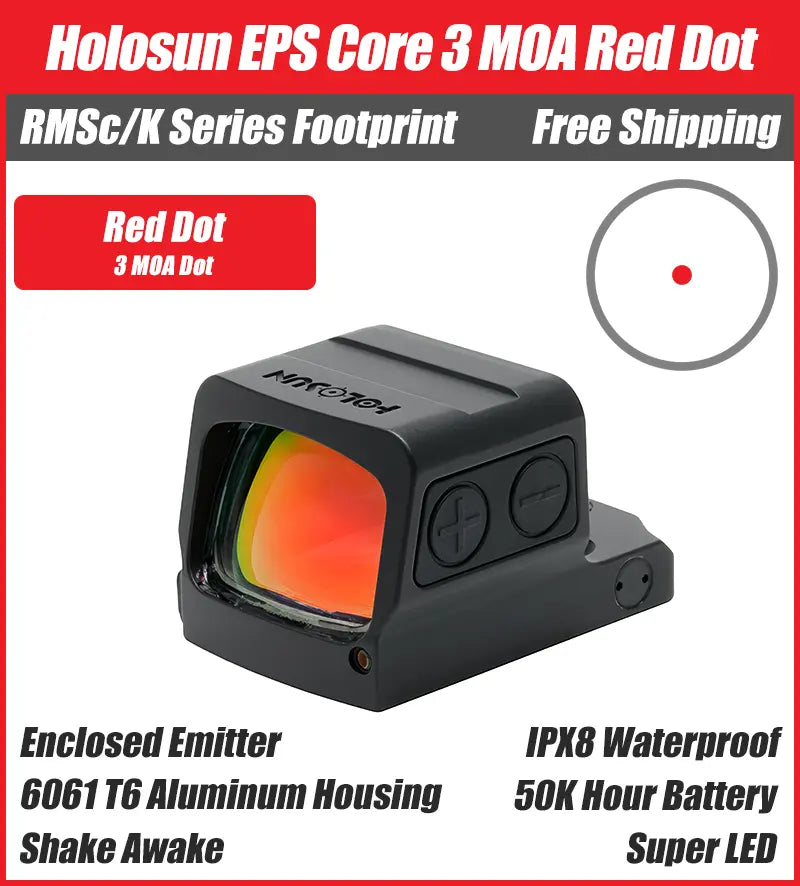
|
Starts at $179.99 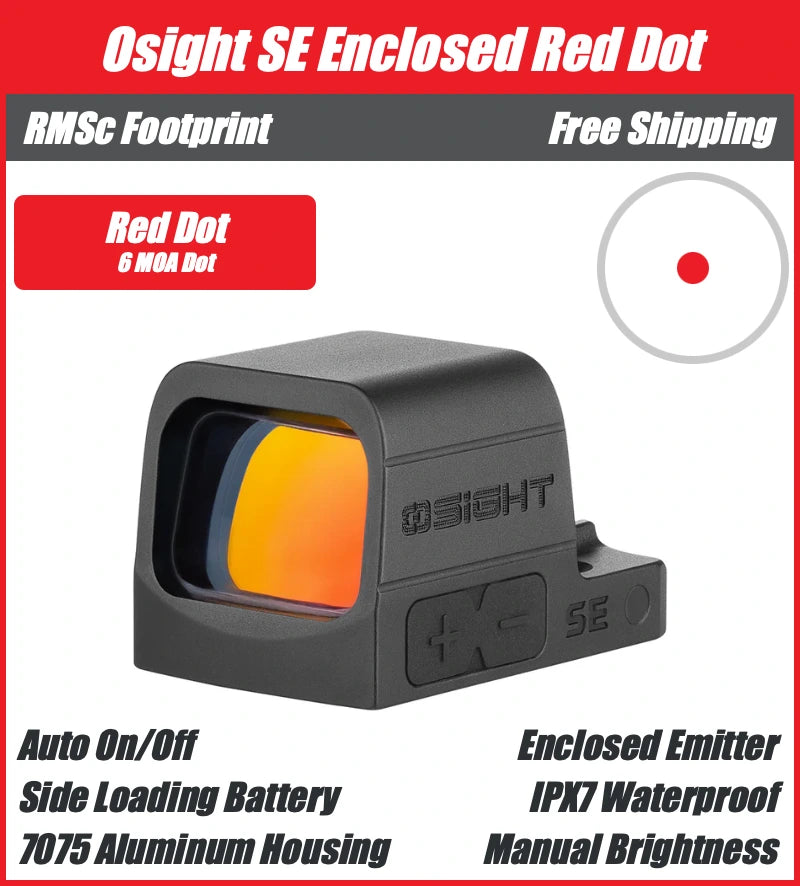
|
Osight SE vs Holosun EPS CORE Specs
| Feature | Holosun EPS CORE | Osight SE |
|---|---|---|
| Footprint | RMSc | RMSc |
| Emitter | Enclosed | Enclosed |
| Window Size | 0.90" × 0.63" | 0.83" × 0.55" |
| Dot Reticle | 3 MOA | 6 MOA |
| MRS Reticle | 2 MOA Dot + 32 MOA Circle | 2 MOA Dot + 32 MOA Circle |
| Reticle Colors | Red, Green, Gold | Red, Green |
| Housing Material | 6061 Aluminum | 7075-T6 Aluminum |
| Battery | CR1620 | CR1620 |
| Battery Location | Side Loading | Side Loading |
| Published Battery Life | 50,000 Hours at Setting 6 | 75,000 Hours at Mode 3 |
| Motion Activation | Yes – Shake Awake | Yes |
| Brightness Settings | 8 Daylight + 4 NV | 8 Daylight + 2 NV |
| Solar | Yes on MRS Models | No |
| Light Sensor | Yes | No |
| Waterproof Rating | IPX8 | IPX7 |
| Adjustment | 1.5 MOA Per Click | 1 MOA Per Click |
| Weight | 1.4 oz | 0.97 oz |
| Dimensions | 1.61" × 1.18" × 0.97" | 1.59" × 0.98" × 0.97" |
| Price Range | $229.99–$299.99 | $179.99–$219.99 |
Similarities Between the Osight SE and EPS CORE

Before getting into the differences, these optics actually have quite a bit in common.
Most importantly, both are enclosed-emitter pistol optics using the RMSc footprint.
That combination makes them especially useful for concealed carry pistols like the 43X/48, Hellcat, and P365.
Both Use a True RMSc Footprint
Both the Osight SE and Holosun EPS CORE use a RMSc footprint, which is commonly found on slimline and micro-compact optics-ready pistols.
One important distinction with the EPS CORE is that it does not use Holosun's K footprint.
The traditional Holosun EPS and EPS Carry use the Holosun K footprint, which is similar to RMSc but not exactly the same. The new EPS CORE uses a true RMSc footprint, allowing it to directly mount to compatible RMSc slides without requiring the adapter plates sometimes necessary with K-footprint optics.
That makes both of these optics attractive options for RMSc-cut concealed carry pistols.

As always, you should still confirm the exact mounting requirements and screws for your specific setup before installation, you can check out our fitment guides for more information.
Both Are Enclosed Emitter Optics

The second major similarity is that both optics are fully enclosed.
With an open-emitter red dot, the LED that projects the reticle onto the lens is exposed. Dirt, lint, water, mud, or other debris can potentially get between the emitter and the lens.
An enclosed optic seals the emitter inside the optic housing.
That is particularly useful on a concealed carry setup that may spend every day exposed to clothing lint, dust, moisture, and other debris.
Historically, choosing an enclosed pistol optic usually meant spending considerably more money. Both the Osight SE and EPS CORE are attempting to bring that feature to a more affordable price point.
Both Have Side-Loading CR1620 Batteries

Battery replacement is also very similar. Both optics use a CR1620 battery located in a side-loading battery tray, which means you do not have to remove the optic from your pistol to replace the battery.
Reticle Options
Reticle selection is where the two optics begin separating themselves.

The Holosun EPS CORE is available with either a 3 MOA Dot or Multi-Reticle System with a 2 MOA Dot and 32 MOA Circle
The MRS version allows you to select between the 2 MOA dot, 32 MOA circle, or the circle-and-dot combination.

The Osight SE is available with either a 6 MOA Dot or Multi-Reticle System with a 2 MOA Dot and 32 MOA Circle
The MRS version similarly gives you the ability to switch between the dot, circle, or circle-dot reticle.
So if you want an MRS reticle, both optics have that option.
The bigger difference is the standalone dot.
3 MOA vs 6 MOA
Holosun chose a 3 MOA dot, while Osight chose a larger 6 MOA dot. Neither one is necessarily better.
A 3 MOA dot gives you a smaller aiming point that can be useful if you prefer a cleaner sight picture or want slightly more precision.
A 6 MOA dot is larger and generally easier to find quickly, which can be beneficial on a concealed carry or defensive handgun where fast dot acquisition is important.
This largely comes down to personal preference.
Holosun Also Offers Gold Reticles
Holosun's color options is another advantage when it comes to reticle selection.
The EPS CORE is available in: Red, Green, or Gold
The Osight SE is available in: Red or Green
Most shooters will probably choose red or green anyway, but Holosun's gold reticle is being more popular with people with an astigmatism. So it is nice that Holosun gives shooters another option if they find that color easier for their eyes to pick up.
Both the 3 MOA and MRS versions of the EPS CORE are available in all three colors.
Window Size

One of the biggest advantages of the EPS CORE is its larger viewing window.
The Holosun EPS CORE has a: 0.90" × 0.63" window
The Osight SE has a: 0.83" × 0.55" window
That might not look like a huge difference on paper, but pistol red dots are small enough that a few hundredths of an inch can make a noticeable difference.
The EPS CORE essentially gives you the viewing window of the full-size Holosun EPS while still using the smaller EPS Carry base.
A larger window gives you more viewing opportunity around the reticle, which can make the dot easier to find during the draw and more forgiving if your presentation is not absolutely perfect.
The tradeoff is overall optic width.
Because of the window size the EPS CORE's top measures 1.18 inches wide, while the Osight SE is only 0.98 inches wide.
So although both use the same RMSc footprint, the Osight SE has the slimmer overall housing.
If your priority is the largest possible viewing window, the EPS CORE has the advantage.
If you want an optic that stays as narrow and compact as possible on a slimline handgun, the Osight SE has an advantage.
Housing Material
The Osight SE gets a clear win when comparing housing materials.
The Osight SE uses 7075-T6 aluminum, while the EPS CORE uses 6061 aluminum.
7075 aluminum is generally a stronger material and is commonly used in more premium pistol optics.
Interestingly, this is one area where Holosun reduced the specification compared with its more expensive EPS and EPS Carry models, which use 7075 aluminum.
Using 6061 helps position the EPS CORE as the more affordable model within the EPS family.
That doesn't mean the EPS CORE has a weak housing. Holosun still rates it for 5000G vibration resistance and IPX8 waterproofing.
But strictly comparing the housing material itself, the Osight SE's 7075-T6 aluminum is the better material on paper.
Size and Weight
The Osight SE is also noticeably lighter.
The Osight SE weighs 0.97 oz.
The EPS CORE weighs 1.4 oz.
The overall dimensions are:
EPS CORE: 1.61" × 1.18" × 0.97"
Osight SE: 1.59" × 0.98" × 0.97"
The EPS CORE gives you the larger window, while the Osight SE gives you the smaller, lighter housing.
Battery Life
Both manufacturers advertise extremely long battery life, but this is a perfect example of why you cannot compare battery-life numbers without looking at how they were tested.
Osight advertises up to 75,000 hours at Mode 3 and Holosun advertises 50,000 hours at Setting 6.
At first glance, it looks like the Osight has significantly better battery life, but that isn't necessarily the case.
The Osight's 75,000-hour rating is measured at Mode 3, which is 1 above its night vision setting, which is barely visible. Holosun's 50,000-hour rating is measured at brightness setting 6, making the two published numbers difficult to directly compare. Both of those numbers are also the dot only, so if you use the MRS reticle you will obviously see a lower battery life compared to 50k/75k advertised hours. It's best to change the battery on a set maintenance schedule yearly, especially if you're using it on your concealed carry.
The important takeaway is that both have extremely long advertised battery life, both use motion activation to conserve battery power, and both allow you to replace the CR1620 battery easily with a side loading battery tray.
Brightness Settings, Motion Activation, and Lockout Mode
Both optics include motion-activated technology, but the Holosun EPS CORE gives you more control over how that system operates.
Holosun calls its motion activation system Shake Awake. By default, the optic will shut down after 10 minutes of inactivity and automatically turn back on when movement is detected.
The important difference is that Holosun allows you to change the sleep timer. You can set Shake Awake to turn the optic off after:
- 10 minutes
- 1 hour
- 12 hours
- Disabled entirely
The Osight SE also includes a motion sensor function, but its sleep timer is fixed at approximately 3 minutes. Once the optic sits still for three minutes, it powers down and wakes back up when movement is detected.
Unlike the EPS CORE, the Osight SE does not allow you to change or disable that timer.
Brightness Settings
Both optics allow you to manually control reticle brightness.
The EPS CORE has 8 daylight settings + 4 night vision settings.
The Osight SE has 8 daylight settings + 2 night vision settings.
For most concealed carry users, either optic provides more than enough usable brightness settings, but Holosun gives you a little more adjustment on the low end for night vision use.
Manual, Automatic, and Lockout Modes
The larger difference is how much control each optic gives you over its operating modes.
The Osight SE primarily gives you manual brightness control. You select your desired brightness level, and the optic maintains that setting while its motion sensor handles turning the optic on and off.
The EPS CORE gives you more flexibility with automatic, manual, and lockout functionality.
In manual operation, you select the brightness level yourself.
The EPS CORE also uses its forward-facing light sensor to respond to changing lighting conditions, giving it additional brightness functionality that the Osight SE does not have.
Holosun also includes a Lockout Mode.
Lockout Mode is particularly useful on a concealed carry handgun because it prevents accidental button presses from changing your settings. If the optic is rubbing against clothing, a holster, or other gear throughout the day, locking the controls helps make sure the optic stays at the brightness setting you selected.
The Osight SE does not offer a comparable lockout function.
For someone who simply wants to set a brightness level and use the optic, the Osight SE's system is straightforward and easy to use.
If you want more control over the sleep timer, additional brightness settings, automatic brightness functionality, and the ability to lock your controls, the EPS CORE has the more advanced operating system.
EPS CORE Light Sensor and Solar Failsafe

This is one of the bigger feature differences between the two optics.
Every EPS CORE has a forward-facing light sensor.
On the non-solar 3 MOA models, Holosun describes this sensor as adjusting reticle brightness based on ambient lighting conditions.
The MRS versions take the technology a step further by adding Solar Failsafe.
Holosun's solar system provides an additional source of power and works alongside the forward-facing light sensor. The MRS models use the sensor to respond to changing lighting conditions while Solar Failsafe provides supplemental power.
The Osight SE does not have a solar system or forward-facing light sensor.
If you want the simplest possible optic, that may not matter.
If you like having additional technology built into the optic, however, the EPS CORE offers considerably more functionality.

Waterproofing and Durability
Both optics are designed to handle normal concealed carry use, but their published waterproof ratings are slightly different.
The Holosun EPS CORE is rated IPX8.
The Osight SE is rated IPX7.
Holosun also publishes a 5000G vibration rating for the EPS CORE.
Again, the Osight counters with its stronger 7075-T6 aluminum housing.
This makes the durability comparison interesting. The Osight has the stronger housing material on paper, while the EPS CORE carries the higher published waterproof rating and Holosun's published 5000G vibration specification.
Price
Price is one of the strongest arguments for the Osight SE.
At the time of writing, pricing is:
| Model | Price |
|---|---|
| Osight SE 6 MOA Red | $179.99 |
| Osight SE 6 MOA Green | $179.99 |
| Osight SE MRS Red | $179.99 |
| Osight SE MRS Green | $186.99 |
| EPS CORE 3 MOA Red | $229.99 |
| EPS CORE 3 MOA Gold | $229.99 |
| EPS CORE 3 MOA Green | $239.99 |
| EPS CORE MRS Red | $279.99 |
| EPS CORE MRS Gold | $279.99 |
| EPS CORE MRS Green | $299.99 |
The Osight SE starts less than the EPS CORE. The difference becomes even larger with the MRS models. So if you're simply trying to get into an enclosed RMSc optic for as little money as possible, the Osight SE is clearly the cheaper option.
The additional cost of the EPS CORE gets you features like the larger window, additional reticle color, more night vision brightness settings, higher waterproof rating, forward-facing light sensor, and Solar Failsafe on MRS versions.
Which One Should You Buy?
The Osight SE and Holosun EPS CORE are targeting essentially the same shooter: someone who wants a compact enclosed RMSc red dot without spending premium-optic money.
But they accomplish that goal differently.
Who Should Buy the Osight SE?

The Osight SE makes the most sense if price is one of your biggest considerations.
Starting at $179.99, it gives you an enclosed emitter, true RMSc footprint, side-loading battery, motion activation, 7075-T6 aluminum housing, and red or green reticle options at a very competitive price.
It's also the smaller and lighter optic of the two.
If you prefer a 6 MOA dot, want a 7075 housing, want the narrowest housing possible, or simply want to spend less money, the Osight SE has a lot going for it.
Who Should Buy the Holosun EPS CORE?

The EPS CORE makes sense for someone willing to spend a little more for additional features.
Its biggest advantage is the larger 0.90" × 0.63" viewing window, which gives you more viewing area while still allowing the optic to mount to a true RMSc footprint.
You also have more reticle choices, including red, green, and gold, plus the choice between a 3 MOA dot or Holosun's Multi-Reticle System.

The EPS CORE also includes the forward-facing light sensor, four night vision brightness settings instead of two, IPX8 waterproofing, and Solar Failsafe when you step up to the MRS model.
If those features matter to you, the additional cost is easy to justify.
|
Starts at $229.99
|
Starts at $179.99
|
Final Thoughts: Osight SE vs EPS CORE
The Osight SE is the better pure budget option. It costs less while still giving you an enclosed emitter, true RMSc footprint, 7075-T6 aluminum construction, side-loading battery, and motion activation.
The Holosun EPS CORE is the more feature-rich option. You're paying slightly more, but you're getting a larger window, more reticle choices, more brightness settings, higher waterproofing, a forward-facing light sensor, and the option for Solar Failsafe.
Ultimately, both optics make enclosed-emitter red dots much more accessible for RMSc-cut concealed carry pistols.
If you're still unsure which optic is right for your handgun, reach out to the Freedom Gorilla customer service team. We'll help you determine what fits your pistol and which optic makes the most sense for how you plan to use it.