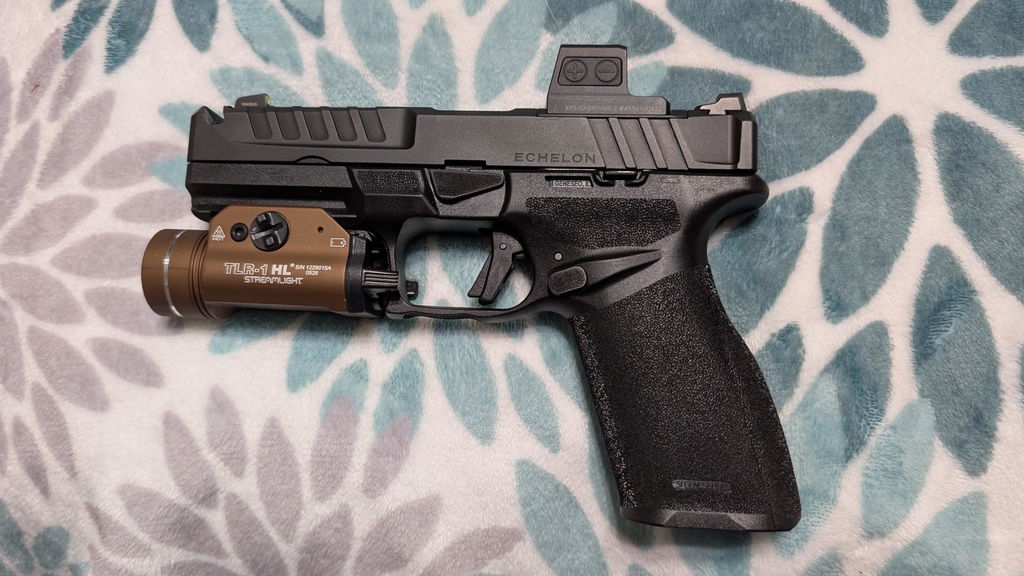
If you own a Gen5 Glock MOS and want to mount a red dot directly to the slide without an adapter plate, two optics are naturally going to come up in the conversation: the Holosun SCS MOS and the Osight SE MOS.
At a high level, the comparison makes perfect sense. They are both pistol red dots designed to mount directly to the Glock MOS cut, both sit extremely low on the slide, and both allow you to avoid the need to use a MOS adapter plate.
But once you get beyond the mounting system, these are actually two very different optics.
The Holosun SCS MOS is an ultra-low-profile, open-emitter optic built around Holosun's advanced Solar Charging Sight technology and a titanium housing.
The Osight SE MOS takes almost the opposite approach. It is an enclosed-emitter optic with a replaceable battery, manual brightness controls, motion activation, and a very unique top-mounted emitter design.
So while these optics will inevitably be compared, we don't really consider this a perfect apples-to-apples comparison. Each one solves the direct-mount Glock MOS problem in a different way.
Important Glock Fitment Information

Before getting into the comparison, there is one extremely important fitment note.
Both of these optics are designed around the Gen5 Glock MOS slide cut.
They are NOT designed for the new Glock Gen6 ORS cut. They also will NOT directly fit the Glock 43X MOS or Glock 48 MOS, which use Glock's narrower Slimline MOS cut.
- Glock Gen5 MOS: Yes
- Glock Gen6 ORS: No
- Glock 43X MOS: No
- Glock 48 MOS: No
If you have a Gen6 Glock or a Slimline Glock, make sure you are shopping for an optic specifically compatible with that slide cut rather than assuming that "MOS" automatically means the same footprint.
|
Starts at $349.99 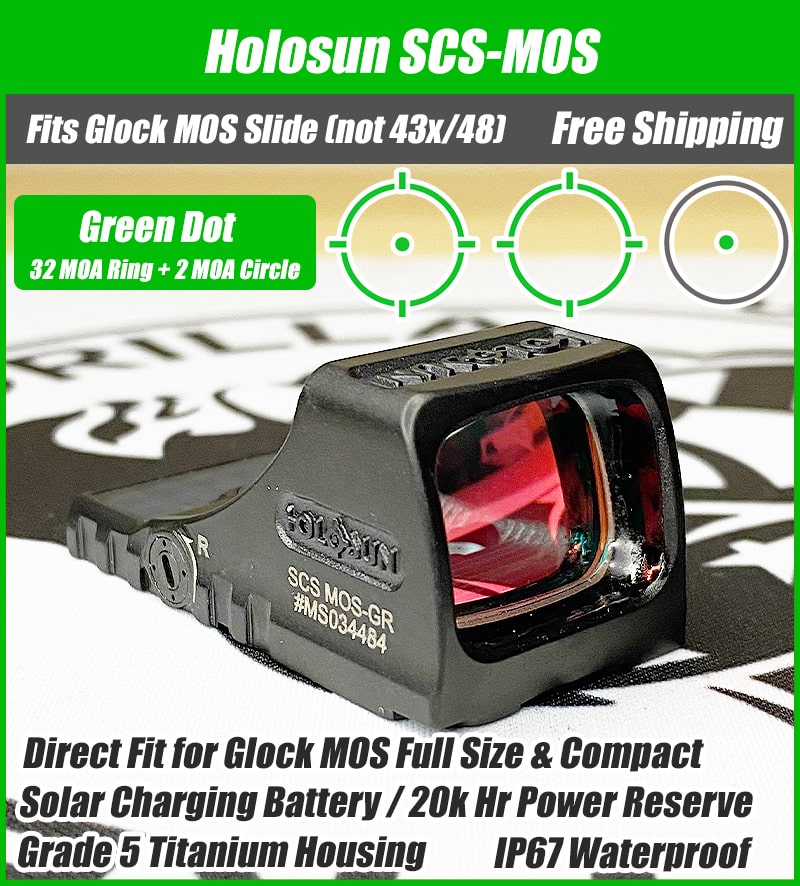
|
Starts at $249.99 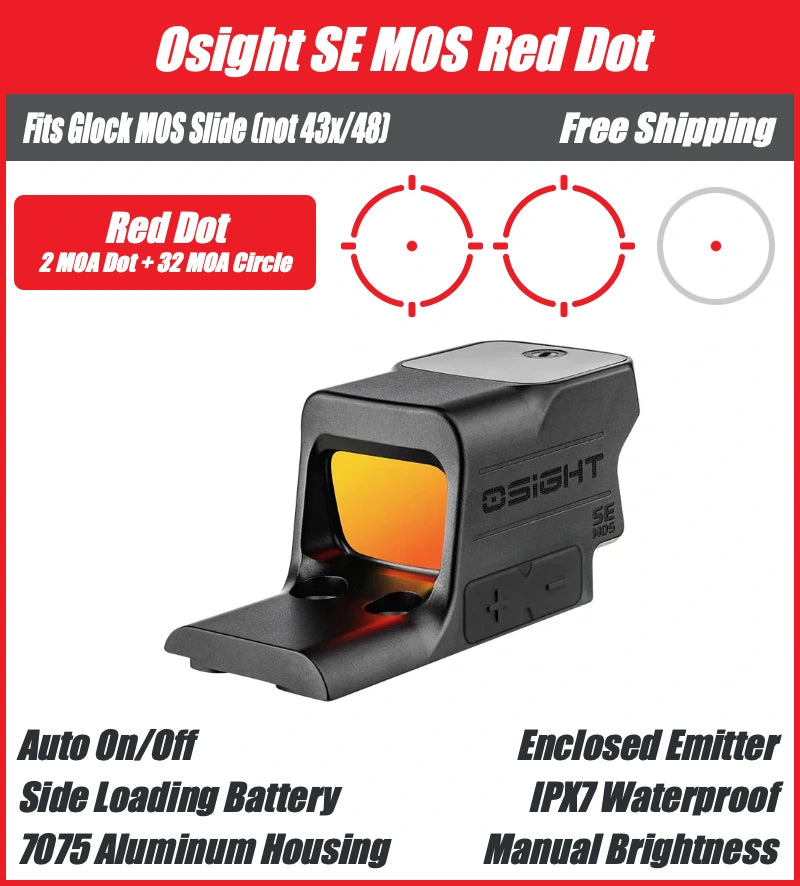
|
Holosun SCS MOS vs Osight SE MOS Quick Comparison
| Feature | Holosun SCS MOS | Osight SE MOS |
|---|---|---|
| Mounting System | Direct Glock MOS | Direct Glock MOS |
| Adapter Plate Required | No | No |
| Emitter | Open | Enclosed |
| Reticle Color | Green | Red |
| Reticle | 2 MOA Dot + 32 MOA Circle MRS | 2 MOA Dot + 32 MOA Circle MRS |
| Housing | Titanium | 7075-T6 Aluminum |
| Window Size | 0.90" × 0.63" | 0.83" × 0.55" |
| Power | Internal Rechargeable Battery + Solar | Replaceable CR1632 |
| Brightness | Automatic + 30-Minute Override | Manual |
| Motion Activation | Turn it on and leave it on | Yes, 3-minute sleep |
| Waterproof Rating | IP67 | IPX7 |
| Weight | 1.3 oz | 1.59 oz |
| Approx. Price | $350 | $250 |
Why Direct Mounting Matters
The biggest thing these optics have in common is also the reason people compare them.
Neither requires a Glock MOS adapter plate.
Normally, a Glock MOS pistol requires a plate between the slide and the optic. A direct-mount optic eliminates that additional layer.
That gives you a few advantages:
- A lower overall optic height
- Fewer screws and mounting interfaces
- A cleaner installation
- Better compatibility with factory-height iron sights
For someone who already knows that the optic is going to live permanently on a Glock MOS pistol, direct mounting makes a lot of sense.
And Holosun deserves some credit here.
The Holosun SCS MOS Is the OG Direct-Mount Glock MOS Optic

The Holosun SCS MOS was the optic that really put the direct-mount Glock MOS concept on the map.
Before the SCS MOS, Glock MOS owners were accustomed to choosing an optic and then choosing the correct adapter plate. Holosun instead designed the optic around the Glock MOS slide itself.
That allowed the SCS MOS to sit extremely low.
The result is one of the cleanest-looking optic installations available on a Glock MOS pistol. It looks more like the optic was designed as part of the pistol rather than something that was added afterward.
That low profile also makes a lot of sense for concealed carry and duty use. There is less optic sticking above the slide, and the low mounting height allows the optic to work with standard-height Glock iron sights.
But the physical design is only part of what makes the SCS MOS interesting.
The SCS Technology
The biggest reason the SCS MOS costs more is its electronics.
SCS stands for Solar Charging Sight, and it operates very differently from a traditional battery-powered pistol red dot.
The optic contains an internal rechargeable battery with up to 20,000 hours of reserve runtime. A solar charging system replenishes that battery when sufficient light is available, while multiple light sensors automatically adjust reticle brightness to match the environment.
There is no battery that you periodically remove and replace.

The idea is essentially:
Install it. Zero it. Pick your reticle. Leave it alone.
That is why we consider the SCS MOS a true set-it-and-forget-it optic.
The optic is designed to remain operational rather than constantly shutting itself down to conserve a disposable battery.
And the charging system is surprisingly efficient. Under sufficient lighting conditions, the solar charging system can replenish energy faster than the optic consumes it during normal use.
That is some seriously cool technology for a pistol red dot.
Automatic Brightness Without Giving Up an Override
The SCS MOS also automatically determines how bright the reticle needs to be.
If you move from a dark room into bright sunlight, the optic senses the change and increases reticle brightness. Move back into a darker environment, and it reduces brightness.
You don't have to hit "+" or "-" buttons every time the lighting changes.
There is still a manual override available when you need it.

A quick press of the button activates a high-brightness override for approximately 30 minutes, giving you additional reticle intensity before the optic returns to its normal automatic operation.
Again, the entire philosophy behind the SCS MOS is minimizing the amount of interaction required from the shooter.
The SCS MOS Has a Titanium Housing
The other massive advantage for the Holosun is its housing.
The SCS MOS uses a precision-machined titanium housing. It is also rated for 5000G vibration resistance and IP67 water resistance.
Titanium gives the SCS MOS an excellent combination of strength and relatively low weight, with the optic weighing approximately 1.3 ounces.
If durability is one of your top priorities, this is one area where we would give the Holosun a meaningful advantage.
No pistol optic is indestructible, but between the titanium construction, low-profile housing, and Holosun's established track record, the SCS MOS is very well suited for a pistol that is going to be carried or used hard.
The tradeoff is that it remains an open-emitter optic.
And that's exactly where the Osight enters the conversation.
The Osight SE MOS Is the Enclosed Direct-Mount Option

The biggest selling point of the Osight SE MOS can be explained in one sentence:
It gives Glock MOS owners an enclosed-emitter optic without requiring an adapter plate at a great price point.
The Osight SE MOS is the first enclosed-emitter optic designed around a direct Glock MOS footprint, which makes it a very unique option.
With an open-emitter optic like the SCS MOS, the LED emitter and the path between the emitter and front lens are exposed.
Normally this is not a problem, but lint, dirt, mud, water, snow, or other debris can potentially interfere with the emitter.
An enclosed optic puts that entire system behind glass.
For concealed carry, duty use, or anyone who simply prefers enclosed pistol optics, that alone may be enough reason to choose the SE MOS.
The Osight SE MOS Has a Very Unique Emitter Design
Osight had to get creative to make an enclosed optic sit this low.
Normally, much of the emitter and electronics are located toward the bottom of an optic. That presents a problem when you're trying to make an enclosed optic mount directly to the relatively shallow Glock MOS cut.
Osight's solution was to move the emitter to the top of the optic and project the reticle downward.

That is why the top portion of the SE MOS housing looks thicker than you might expect.
The design also changes the angle of the front lens. Combined with the aspherical lens, the unusual lens angle helps create a very clean sight picture while reducing distortion and unwanted glare. It is one of the more innovative parts of the optic.
And yes, when you first see the SE MOS by itself, it looks a little goofy. The rear extension almost looks like somebody put a tiny spoiler on a red dot... that should at least add five horsepower to your Glock.
But once you install it on a Glock MOS slide, the design starts making more sense. It contours around the rear of the slide and looks much more intentional when it's actually mounted on the slide.
The Rearward Position Is Actually Pretty Nice
Another interesting part of the SE MOS design is how far rearward the optic sits.
Because of its shape and mounting system, the window ends up fairly close to the shooter's eye compared with many traditional plate-mounted pistol dots.
In our experience, that can make the window and reticle feel a little easier to pick up.
The window itself measures approximately 0.83 × 0.55 inches, but bringing the window slightly closer to your eye can make the usable field of view feel larger than the raw dimensions suggest. That's a small detail we didn't really appreciate until seeing the optic mounted.
Is the Top-Mounted Technology a Durability Concern?
There is a potential tradeoff to the SE MOS architecture.
Because the emitter and more of the optic's structure are located above the viewing window, the housing is thicker across the top.
That also puts more of the design in an area that could potentially take the initial impact during certain drops but that does not automatically mean the SE MOS is fragile.
Its housing is still CNC-machined from 7075-T6 aluminum, which is a great and common material for a pistol optic.
However, we have also seen ShortShot Tony drop testing where an SE MOS sample cracked after a hard impact.
One drop test on one optic should never be treated as proof that every optic will fail the same way, but it is something worth considering if extreme impact resistance is your number-one priority.
This is an area where we would personally give the titanium SCS MOS the advantage.
The Holosun has a simpler, lower-profile housing made from titanium, and that is exactly the type of construction we would prefer if the pistol were going to see particularly hard duty use.
Osight Uses a Normal Replaceable Battery
The SE MOS takes a much more traditional approach to power. It uses a CR1632 battery located inside a side-loading battery tray, and there are advantages to this approach. Some shooters simply prefer having a normal battery that they can replace themselves rather than relying on a permanently installed rechargeable battery. Put a fresh CR1632 in the optic on a regular schedule and you know exactly what is powering it.
Osight advertises up to 140,000 hours of battery life in dot-only Mode 3, although actual battery life will depend on reticle selection, brightness level, and usage.
Motion Activation and Manual Brightness
The Osight SE MOS operates much more like a conventional pistol red dot.
It has physical brightness controls with:
- 8 daylight brightness settings
- 2 night-vision settings
- Brightness memory
The optic also uses a motion sensor.
After approximately three minutes without movement, the SE MOS powers down to conserve battery. As soon as the pistol moves again, the optic wakes back up.
That is very different from the philosophy behind the SCS MOS.
The Osight says:
"I'll go to sleep when you aren't using me and save the battery."
The Holosun essentially says:
"Why go to sleep? I'll just keep myself charged."
Neither approach is inherently wrong. They are simply solving the same problem differently.
Manual Brightness vs Automatic Brightness
This is another major difference.
The Osight SE MOS uses manual brightness controls.
If the reticle is too dim, press the "+" button.
If it is too bright, press the "-" button.
The SCS MOS automatically handles brightness for you using its light sensors.
For shooters who like complete control over their brightness setting, the Osight may actually be preferable.
But from a technology standpoint, the Holosun is more advanced. The ability to continually monitor the surrounding environment, automatically adjust reticle brightness, charge its own internal battery, and essentially operate without the shooter thinking about any of it is what makes the SCS system so interesting.
The Osight SE MOS does not have automatic brightness, and it does not offer a traditional lockout mode for its brightness controls.
In practical terms, the SCS MOS requires very little button interaction in the first place because automatic brightness is its normal operating mode.
Both Have the Same Basic Multi-Reticle Concept

Both optics offer the same reticle choices, with the only difference being color.
- 2 MOA dot
- 32 MOA circle
- 2 MOA dot + 32 MOA circle
The Holosun SCS MOS uses a green reticle.
The Osight SE MOS uses a red reticle.
For some people, that alone could make the decision. If your eyes strongly prefer green, the SCS MOS has the advantage. If you prefer a traditional red reticle, the SE MOS gives you that option.
Price: $350 vs $250
Then we get to one of the biggest differences:
Holosun SCS MOS: approximately $350
Osight SE MOS: approximately $250
And price is one of the reasons Osight has become popular. You are getting a lot of optic for the money. But it is also important to understand why the SCS MOS costs more.
The additional money is buying you things like:
- Titanium housing
- Solar charging
- Internal rechargeable power
- Multi-directional light sensors
- Automatic brightness adjustment
- 30-minute brightness override
- Extremely low-profile construction
- Holosun's longer track record in pistol optics
The SE MOS gives up some of that technology to hit a lower price point, and that is completely fine because not everyone needs the extra technology.
In exchange, the Osight gives you something the SCS MOS doesn't: an enclosed emitter and a user-replaceable battery.
Which One Should You Buy?
This isn't really a situation where one optic wins every category.
They are designed for different buyers.
Get the Osight SE MOS If...
The Osight SE MOS makes the most sense if you:
- Specifically want an enclosed-emitter optic
- Want to mount directly to a compatible Glock MOS slide without a plate
- Prefer a replaceable CR1632 battery
- Want manual brightness controls
- Like motion activation / Shake Awake-style operation
- Prefer a red reticle
- Want to spend around $250 instead of $350
- Want an enclosed optic while still maintaining a very low mounting height
Get the Holosun SCS MOS If...
The Holosun SCS MOS makes more sense if you:
- Want the most advanced technology
- Prefer an extremely low-profile optic
- Want a titanium housing
- Prioritize durability
- Want automatic brightness adjustment
- Like the idea of a solar-charging internal battery
- Want an optic you can essentially install and forget about
- Prefer a green reticle
- Want an optic for concealed carry, duty use, or a hard-use pistol where simplicity and durability are priorities
|
Starts at $349.99
|
Starts at $249.99
|
Final Thoughts
The Holosun SCS MOS and Osight SE MOS are going to be compared constantly because they occupy a very small category: pistol optics that mount directly to a full-size Glock MOS slide without an adapter plate.
But they really represent two different philosophies.
The Holosun SCS MOS is about minimizing maintenance and maximizing technology.
Install it, zero it, select your reticle, and let the optic handle the rest.
The Osight SE MOS is about giving you an affordable enclosed-emitter direct-mount optic while keeping familiar features like a replaceable battery, manual brightness adjustment, and motion activation.
We don't think either design makes the other irrelevant.
If you want the more technologically advanced, extremely low-profile optic with a titanium housing, we'd lean toward the Holosun SCS MOS.
If your priority is getting an enclosed emitter directly onto your Glock MOS without a plate, while saving roughly $100 in the process, the Osight SE MOS makes sense.
Just remember that neither optic is designed for the Glock Gen6 ORS cut or the Glock 43X/48 Slimline MOS cut.
And if you're still not sure which optic makes the most sense for your Glock, reach out to the Freedom Gorilla customer service team. We'll help you figure out exactly what fits your pistol and which optic better matches what you're trying to do.