Hey Freedom Gorillas, today we wanted to take a stab at the Trijicon RMR vs. SRO debate, and find out how different they are and whether each will serve the competitive shooters, range shooters, speed shooters, or those who want an optic for duty use or ccw/edc.
Obviously, we don’t want to pick sides, but we do want to explore each optic and what makes each stand out.
In this article we will cover the main features and key differences between the Trijicon RMR and Trijicon SRO, and we will discuss which optic prevails depending on your preferences and circumstances.
So, let’s dive in:
TLDR
The Trijicon RMR Type 2 and Trijicon SRO are both red dot optics in the Trijicon lineup with an RMR footprint. They are designed to fit full size or compact pistols with two different purposes. The RMR is designed for concealed carry and everyday carry since it has a small profile and easily concealable design.

The RMR is also ideal for duty and hard usage since its square construction and “owl ear” shape makes it more impervious to shock and damage. The Trijicon SRO is ideal for competitive shooting and range use since it has a larger viewing window with a circular shape.
This aids in quicker target acquisition since objects are easy to capture in the field window, and makes it easier to find the dot after firing. It’s ideal for those looking for speed and precision especially when moving between targets.
The RMR has three main models: Adjustable, Automatic, and Dual Illuminated. The RMR Adjustable has your choice of a 1 MOA dot, 3.25 MOA dot, or 6.5 MOA dot. The RMR Automatic has a 3.25 MOA dot, while the Dual Illuminated has a 9 MOA dot.
The Adjustable and Automatic use a CR2032 battery while the Dual Illuminated uses fiber optics and tritium to absorb outside light and use it to light the reticle. The Trijicon SRO comes with a 1 MOA dot, 2.5 MOA dot, or 5 MOA dot and uses a replaceable CR2032 battery.
The battery of the SRO can easily be replaced while mounted thanks to the top mounted battery compartment while the battery of the RMR is changed through the bottom of the optic and therefore must be removed and rezeroed when changing the battery.
The SRO is best for competitive shooters while the RMR is best for ccw and edc and those who want a more durable optic. Both the RMR and SRO come in at a similar price with the standard RMR Type 2 Adjustable coming in at $554.00 and the SRO coming in at $585.00.
|
Starts at $514.99 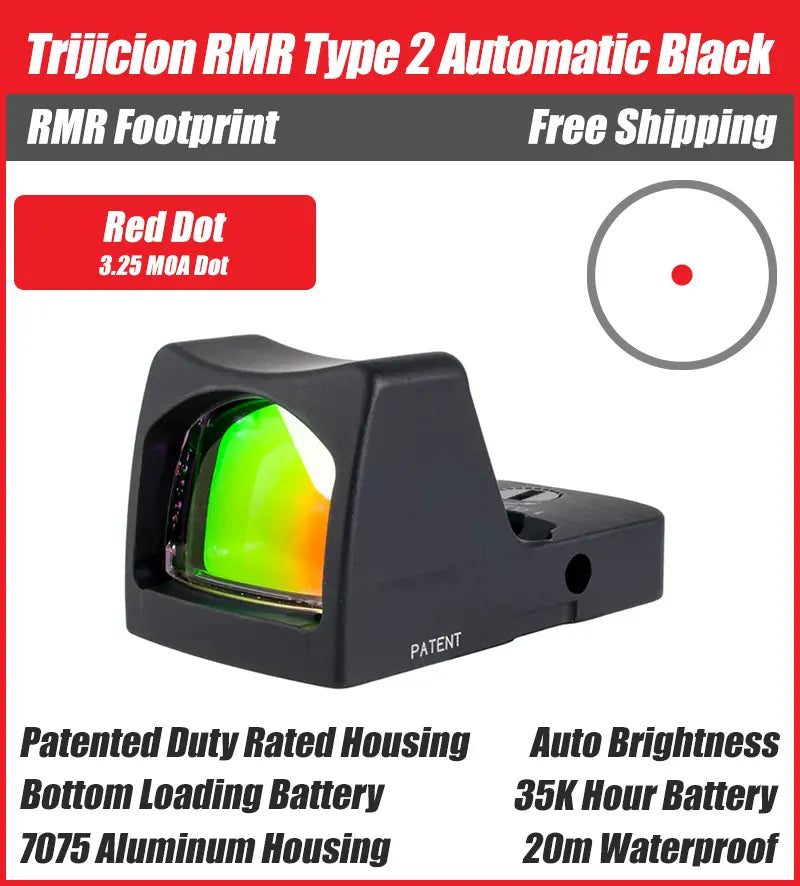
|
Starts at $585.00 
|
Quick Overview of the Trijicon RMR and Trijicon SRO
The Trijicon RMR, or Ruggedized Miniature Reflex, is designed to be a durable duty-use optic while the Trijicon SRO, or Specialized Reflex Optic, is designed to be used for better shooting accuracy and speed, making it the most applicable for target and competitive shooting.
The RMR comes in multiple models including the Adjustable, Automatic, and Dual Illuminated with various reticle options, while the SRO is a singular model with three reticle options.
Here’s a breakdown of all of the specifications and features of both optics:
Quick Breakdown
|
Footprint Type |
RMR Footprint |
RMR Footprint |
|
Reticle Color Options |
Red, Green, or Amber (Depending on the Model) |
Red |
|
MOA Sizes |
1, 3.25, and 6.5 MOA |
1, 2.5, and 5 MOA |
|
Battery Type |
CR2032 |
CR2032 |
|
Solar Failsafe |
No |
No |
|
Battery Life |
Over 4 Years of Continuous Use (35,000 Hours) |
Over 3 Years of Continuous Use |
|
Brightness Levels |
8 Brightness Settings: 6 Daylight and 2 Night Vision Compatible |
8 Brightness Settings: 6 Daylight and 2 Night Vision Compatible |
|
Window Dimensions |
0.87”x0.63” |
0.98”x0.89” |
|
Weight |
1.2 oz |
1.6 oz |
|
Dimensions (LxWxH) |
1.8”x1.1”x1” |
2.2”x1.3”x1.4” |
|
Housing Material |
7075 T6 Forged Aluminum |
7075 T6 Forged Aluminum |
|
Key Features |
|
|
|
Warranty |
|
|
Design Philosophy & Intended Use

Both the Trijicon RMR and Trijicon SRO were designed with different purposes in mind. For instance, the Trijicon RMR has a square housing design with a slight slope down the middle of the hood. This design makes it a more convenient fit for concealed carry use and is intended as a rugged, hard-use reflex sight.
The Trijicon SRO has more of a spherical window design. This may not make it as convenient for concealed carry or everyday carry, however the spherical design does allow for a larger sight window. This automatically makes the SRO stand out for use on the range and for close distance shooting.
Both the RMR and SRO have the Trijicon RMR footprint, allowing both optics to attach directly to many full-size and compact pistols.
Window Size, Field of View & Sight Picture
If you’re looking for a larger sight window, the SRO is the way to go. The Trijicon SRO has a window that is 0.98”x0.89” while the RMR has a window size of 0.87”x0.63”. The spherical shape of the SRO’s lens also gives a larger field of view.
This is where the SRO is superior when it comes to faster target acquisition and therefore may be the better choice for competitive shooters and people who plan on close range shooting. The smaller window and square design on the RMR makes it the more compact and durable option.
Durability, Ruggedness & Hard-Use Performance
The overall design and shape of both optics influences their durability. Since the RMR has a square housing design with the owl shape and thicker aluminum, it is more likely to stand up to the SRO in terms of ruggedness.
The larger circular sight window of the SRO, although great for field of view, creates some issues when it comes to durability. Users have complained that the durability is lacking and that dropping the SRO or hitting it can cause noticeable damage, however, there are other reviews out there that say the opposite.
The general design of the Trijicon SRO does seem to make it more prone to damage compared to the more protected window of the RMR. For everyday competitive use, the SRO should be a great choice, especially since the design of the SRO is more focused on competition. The larger window allows for easier and quicker target acquisition and helps you find the dot more quickly as you are firing.
Dot Size, Reticle & MOA Options

Now, when it comes to variety, the RMR has the SRO beat. However, the options the RMR has can also be slightly overwhelming. The RMR comes in Adjustable, Automatic, and Dual-Illuminated versions.
The RMR Adjustable has auto and manual brightness and comes in Black, Grey, or FDE. The RMR Automatic has auto brightness only and comes in OD Green, Grey, FDE, or Black. The Dual Illuminated uses fiber optics and tritium to illuminate the optic and comes in OD Green housing with Green dot, Black housing with Amber dot, FDE housing with Amber Dot, or Grey housing with Green dot.
The RMR Adjustable comes with a 1, 3.25, or 6.5 MOA dot, depending on the color, while the RMR Automatic only has a 3.25 MOA dot option. The Dual-Illuminated only comes with a 9 MOA dot option.
The SRO only comes in a black housing with your choice of a 1, 2.5, or 5 MOA red dot. If you’re looking for more options the RMR is worth looking into, but the SRO still has the same range of MOA dot sizes to choose from compared to the standard RMR, the RMR just has more variety in terms of models and housing options.
Brightness Controls & LED Performance
The Trijicon SRO has auto and manual brightness with 8 manual brightness settings: 6 for daytime use and 2 night vision compatible settings. The RMR Adjustable has both auto and manual brightness, the RMR Automatic has auto brightness, and the RMR Dual Illuminated has only auto brightness.
Both the SRO and the RMR with manual brightness have buttons on the side of the housing, the plus (+) is on the left side and the minus (-) is on the right. Clicking either button allows you to toggle between brightness settings.
The RMR Automatic has a sensor that detects the surrounding light to automatically adjust brightness while the RMR Dual Illuminate’s brightness is dictated by the environmental lighting, since the fiber optics are powered by the light.
Both the RMR and SRO perform very well in harsh lighting conditions. The manual settings for each feature a “super bright” mode to combat those sunny conditions and the automatic brightness modes help during highly transitional lighting conditions.
In terms of LED performance, the SRO and RMR are equal in clarity and performance. The reticle options allow for long range or short range use. The one optic that does get mixed reviews in terms of reticle clarity is the Dual Illuminated, but this may be due to its reliance on ambient light to power the reticle.
Battery Life & Power System
The battery life varies for the RMR models: the Trijicon RMR Adjustable has a projected battery life of over 4 years, or 35,000 hours, of continuous use, and the Trijicon RMR Automatic has up to 2 years of typical use. The projected battery life of the Trijicon SRO comes in the middle of that at 3 years of continuous use.
The RMR Adjustable, RMR Automatic, and SRO use a replaceable CR2032 battery, but when deciding between the two, it’s important to know where the battery compartments are. For the RMR, the battery is accessed via the bottom of the optic. This means you will have to remove the optic if you need to change your battery and will therefore also have to rezero it. It also means that you need a seal plate under the optic to prevent water from getting into the battery area of the optic.
The SRO has a top-access battery so you can change the battery while the optic is still mounted and don’t have to worry about water damage. The one issue with the SRO is that the space is tight where the battery access is, so you have to be patient when opening it.
It’s worth noting that there have been complaints about the battery connection on the SRO, highlighting that the battery panel doesn’t allow for the battery to make the proper connection.
Compared to its competition like the Aimpoint Acro P2 or Holosun’s optics, the RMR is slightly antiquated with its bottom-mounted battery. Most optics on the market today feature a top-loaded or side-loaded battery compartment, allowing for easy battery access while the optic is mounted.
Also, the projected battery life of the RMR and SRO don’t fully compete with the ACRO P2 or Holosun optics, which can boast 50,000 + hours of battery life.
Mounting, Footprint & Compatibility
Both the SRO and RMR feature the Trijicon RMR footprint which can fit many full size and compact pistols. These pistols include some Glock models (Gen6 ). Even other Glock MOS models like the Glock 19 can fit the RMR footprint with the use of an adapter plate. Need to find the right adapter plate for your pistol? Use our adapter plate finder for your perfect match.
Since the RMR has a smaller profile it can be mounted with the iron sights either behind or in front of the optic. The larger size of the SRO doesn’t allow for this to be an option. However, with a direct mount, both optics have cowitnessing capabilities.
Something to keep in mind is that the SRO has more bulk and risks overhanging the ejection port of your pistol. This can be risky, so you want to make sure it will fit your pistol without blocking it. It can also affect how it mounts with adapter plates, and we have heard from some users that a shim may be required when a pistol’s slide is cut too deep.
Also, since it will be closer to the ejection port, you may also see more carbon build up over time.
Holster Compatibility & Concealed Carry

The effectiveness of each optic in a concealed carry context mostly comes down to shape and the amount of material. The shape of the optic is going to hinder how well it fits in the holster and this is true with the SRO.
As mentioned before, the SRO has a circular lens shape making it slightly awkward to carry. The SRO is also bulkier at the front and sides and slightly heavier than the RMR, which can affect the overall comfort of concealment. The large window makes it great for competitive shooting but not the best for ccw or edc.
The RMR is the preferred choice for carry, mainly because of its compact design. The square design and “owl ear” shape not only provide better protection from shock and heavy duty use, but it also makes it a better fit for concealment. It has less material, less bulk, and less weight than the SRO.
Emitter Design & Environmental Exposure
Both the RMR and SRO from Trijicon feature an open emitter. This means that the emitter is exposed while enclosed optics like the Trijicon RCR have a second panel of glass behind the emitter as extra housing to completely enclose it.
Since the emitter is exposed there is a risk of debris blocking the emitter, however, the fact that both the SRO and RMR can be submerged in water up to a point means that the emitter is still durable against the elements as long as they aren’t excessive..
The open emitter design does mean that water can pool near the emitter and affect the appearance of the reticle, or debris and mud can cake over the emitter. For this reason, it isn’t recommended you take either optic into harsh conditions and should probably consider an enclosed optic like the RCR.
The RMR and SRO are still durable like the RCR. They can still face the elements and handle some water submersion, so if you aren’t looking for a super heavy duty option, the RMR and SRO are just as viable as the RCR.
RMR Type 2, RMR HD & New Trijicon Options
In this article, we have been discussing the different models of the RMR Type 2. This is an upgrade from the original Type 1 and is the model you are most likely to encounter when searching for the RMR.
The RMR Type 2 includes the Automatic, Adjustable, and Dual Illuminated, and there is also the RMR HD. The Trijicon RMR HD is an upgrade from the RMR Type 2 and features a multi-reticle system (MRS) with a 1 or 3.25 MOA dot and a 55 MOA circle. It has manual and auto brightness with a front facing light sensor for automatic adjustments.
The RMR HD also has a top-loaded battery, an improvement from the RMR Type 2, an index ridge to help with target acquisition, more tactile and audible controls, and an extra night vision setting.
Another Trijicon option we already mentioned is the Trijicon RCR. This optic was made with an enclosed design to make it more friendly to heavy military and law enforcement duty use. It also uses Capstan screws so it can be made perfectly snug when mounted.
Competition vs Duty vs Carry Use Cases
The Trijicon SRO is built for competition and is the choice when it comes to shooting on the range and speed shooting because of its larger viewing window. The window gives a greater field of view, making it easier to acquire targets quickly.
Those who use an optic for duty use are more likely to choose the RMR because of its shape and durability. The square shape makes it less susceptible to cracking or breaking from rough usage. This compact square shape also makes the RMR ideal for concealed carry.
While the RMR could be a great addition to your concealed carry weapon, the SRO is ideal for your range-only pistol. This can act as your go-to for range use and is best for USPSA trials and fast target transitions since the field of view is so large.
RMR vs SRO vs Other Red Dot Optics
Compared to its competition, the Trijicon RMR and SRO can come in on the expensive side. They have many of the same features that can be found with Holosun and Aimpoint like button lock out and lock in features, adjustable brightness settings, and 7075 aluminum housing, but are still on the pricier side.
One of the main differences is that the Trijicon red dot optics don’t feature an auto on/off function like the Holosun’s Shake Awake technology. Instead, the RMR has a battery conservation mode that adjusts the brightness automatically to ambient light after 16.5 hours of use.
Compared to the Aimpoint Acro P2, the SRO and RMR are pretty similar in durability, but the ACRO can be submersed more and it is an enclosed optic, providing more protection.
The SRO and RMR are considered to be higher end optics in the grand scheme of red dot optics, coming in at a higher price point but also offering more features for full size and compact pistols.
Pros & Cons of the Trijicon RMR
Pros
What makes the Trijicon RMR great is the fact that it is durable and rugged. The square shape and “owl ear” design make it ergonomically more resistant to shock and collisions. It’s less bulky than the SRO and therefore is the ideal choice for concealed carry, especially since the profile is slim and blends seamlessly when mounted.
Cons
Compared to the SRO, the window size is smaller and field of view is tighter, so it’s harder to track the dot and doesn’t allow you to acquire targets as quickly or easily. This also makes it less competition-focused compared to the SRO.
The RMR also has a bottom-loaded battery compartment, meaning you have to remove the optic to replace the battery and therefore must rezero it afterwards.
Pros & Cons of the Trijicon SRO
Pros
The main pro for the SRO is that it has a larger window. The circular-shaped lens provides a larger field of view which makes it easier and faster to acquire targets and also makes it easier to find the dot.
All of this makes the SRO excellent for fast shooting and competition. The SRO also has a top-loaded battery and therefore doesn’t need to be removed in order to replace the battery.
Cons
Since it has a larger window, the SRO is also bulkier and weighs more than the RMR. This makes it more difficult to conceal with a limitation on holster compatibility. The shape also makes it more susceptible to damage compared to the RMR which is more rugged and durable.
Something else to keep in mind is that the SRO has more material that sticks out to the front and side, which means it can be closer to the ejection port on many pistols and therefore can risk slightly covering the port or just experiencing more carbon build up.
Who Should Choose the RMR?
If you are looking for an optic with an RMR footprint for concealed carry or edc or for duty and hard-use, the Trijicon RMR is a good choice. It is far more rugged than the SRO and features a more streamlined profile for a more comfortable and less noticeable concealed carry.
This is also a good optic for Glock owners who value durability and don’t mind sacrificing window size.
Who Should Choose the SRO?
For those who want a reliable optic for competition or range-focused shooting, the SRO is the better option. You should choose the Trijicon SRO if you don’t mind sacrificing some durability for a larger window. This is for shooters who prioritize speed and tracking and want to easily find the dot after each shot.
Although many users report it not being as durable as the RMR, it still has a durable design and automatic brightness that makes it reasonable for outdoor use.
|
Starts at $514.99
|
Starts at $585.00
|
Price
The Trijicon RMR is the more affordable option out of the two and comes with more options. Here is a breakdown of the pricing:
Trijicon RMR Type 2 Adjustable:
- Trijicon RMR Type 2 Adjustable Red Dot 1 MOA: $554.00
- Trijicon RMR Type 2 Adjustable Red Dot 3.25 MOA: $554.00
- Trijicon RMR Type 2 Adjustable Red Dot 6.5 MOA: $554.00
- Trijicon RMR Type 2 Adjustable Red Dot 1 MOA (FDE): $595.00
- Trijicon RMR Type 2 Adjustable Red Dot 3.25 MOA (FDE): $595.00
- Trijicon RMR Type 2 Adjustable Red Dot 6.5 MOA (FDE): $595.00
- Trijicon RMR Type 2 Adjustable Red Dot 1 MOA (Grey): $595.00
- Trijicon RMR Type 2 Adjustable Red Dot 3.25 MOA (Grey): $595.00
- Trijicon RMR Type 2 Adjustable Red Dot 6.5 MOA (Grey): $595.00
- Trijicon RMR Type 2 Adjustable Red Dot 1 MOA (OD Green): $595.00
- Trijicon RMR Type 2 Adjustable Red Dot 3.25 MOA (OD Green): $595.00
- Trijicon RMR Type 2 Adjustable Red Dot 6.5 MOA (OD Green): $595.00
Trijicon RMR Type 2 Automatic:
- Trijicon RMR Type 2 Automatic Red Dot 3.25 MOA: $514.99
- Trijicon RMR Type 2 Automatic Red Dot 3.25 MOA (FDE): $555.00
- Trijicon RMR Type 2 Automatic Red Dot 3.25 MOA (OD Green): $555.00
- Trijicon RMR Type 2 Automatic Red Dot 3.25 MOA (Grey): $555.00
Trijicon RMR Type 2 Dual Illuminated:
- Trijicon RMR Type 2 Dual Illuminated 9 MOA Amber Dot: $609.99
- Trijicon RMR Type 2 Dual Illuminated 9 MOA Green Dot: $609.99
- Trijicon RMR Type 2 Dual Illuminated 9 MOA Amber Dot (FDE): $659.99
- Trijicon RMR Type 2 Dual Illuminated 9 MOA Green Dot (FDE): $659.99
Trijicon SRO:
- Trijicon SRO Red Dot 1 MOA: $585.00
- Trijicon SRO Red Dot 2.5 MOA: $585.00
- Trijicon SRO Red Dot 5 MOA: $585.00
Final Verdict: Trijicon RMR vs SRO
At the end of the day, the Trijicon RMR is the more durable option that is meant for more heavy duty use and has the right profile and shape for more effective concealed carry circumstances. The Trijicon SRO has the larger circular viewing window making it ideal for competition shooting and range use.
If you’re choosing the RMR, you’ll be trading overall competitive performance for durability while with the SRO you will be trading concealment for that competitive edge. Something else to consider is the RMR has more options when it comes to housing colors and models, and a greater defense against submersion.
You can buy either the Trijicon RMR Type 2 (Automatic, Adjustable, or Dual Illuminated) or the Trijicon SRO here on our website. We also have the full lineup of Trijicon red dot sights including the Trijicon RCR and Trijicon RMR HD.
We hope you found this article helpful, and if you have any questions, don’t hesitate to reach out and let us know; we love to help in any way we can!